The most talked-about runway moments of the past season weren’t the garments. They were the voices. As luxury houses search for ways to restore genuine emotional weight to Fashion Week presentations, the soprano singer fashion week pairing has emerged as the defining artistic statement of 2026, transforming polished but predictable showcases into experiences that stop a room entirely.
If you’ve felt that recent runway productions, however visually stunning, have begun to feel curated for a screen rather than felt in a room, you’re not alone. Creative directors and event producers are grappling with the same tension: how do you command the full attention of an audience that has seen everything, without sacrificing the precise pacing a couture collection demands?
This article explores the “Fashion Opera” movement reshaping luxury presentation, why the world’s most discerning fashion houses are commissioning live operatic performance as a foundational element rather than an afterthought, and what it takes to select a soprano whose presence genuinely elevates a collection rather than competing with it. From the principles behind a bespoke Luxury Opening Moment to the anatomy of a full Signature Fashion Opera Experience, what follows is a considered guide to the new era of live couture artistry.
Key Takeaways
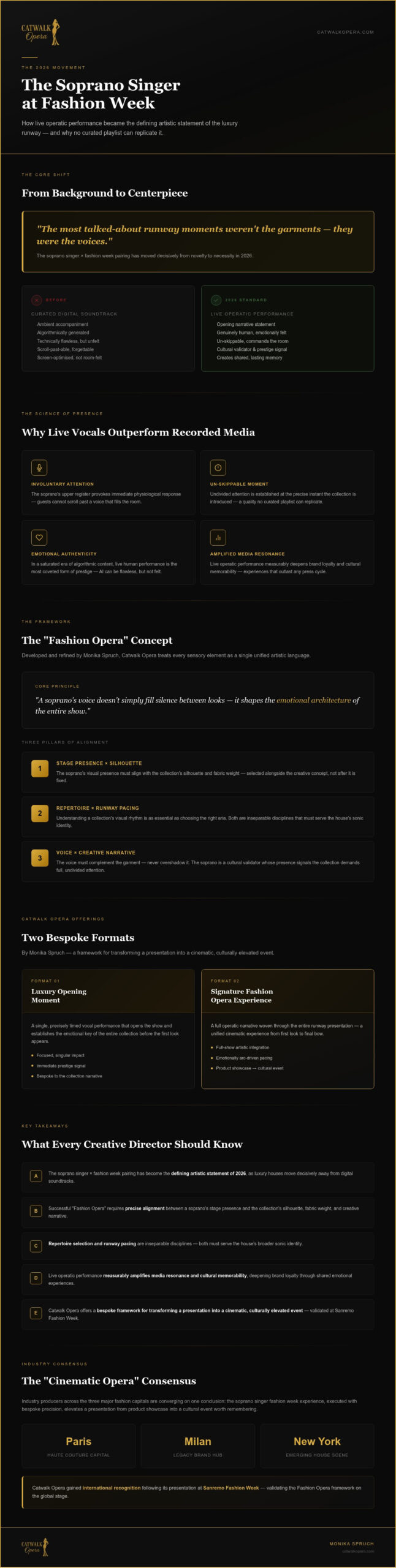
- The soprano singer fashion week pairing has become the defining artistic statement of 2026, as luxury houses move decisively away from digital soundtracks toward live, human-centric vocal experiences that command genuine emotional presence in the room.
- A successful “Fashion Opera” concept requires precise alignment between a soprano’s stage presence and a collection’s silhouette, fabric weight, and creative narrative — the voice must complement the garment, never overshadow it.
- Repertoire selection and runway pacing are inseparable disciplines: understanding a collection’s visual rhythm is as essential as choosing the right aria, and both must serve the house’s broader sonic identity.
- Live operatic performance measurably amplifies a runway show’s media resonance and cultural memorability, deepening brand loyalty through shared emotional experiences that no curated playlist can replicate.
- Monika Spruch’s Catwalk Opera — the visionary concept behind the Luxury Opening Moment and Signature Fashion Opera Experience — offers fashion houses a bespoke framework for transforming a presentation into a cinematic, culturally elevated event.
The Ascent of the Soprano Singer at Fashion Week 2026
Something shifted in the global fashion calendar this season. The most talked-about runway moments weren’t defined by set design or celebrity front rows; they were defined by a single human voice cutting through the silence before the first look even appeared. The soprano singer fashion week pairing has moved decisively from novelty to necessity, and the creative directors driving that change are doing so with clear artistic intent.
The transition away from curated digital soundtracks reflects something deeper than aesthetic preference. It signals a broader reckoning within luxury marketing: that emotional authenticity, in an era saturated with algorithmically generated content, has become the most coveted form of prestige. AI-assisted audio can be technically flawless. It cannot be genuinely felt.
Why Live Vocals Outperform Recorded Media
The physiological effect of a live soprano voice on a seated audience is both immediate and measurable. The soprano voice tradition spans centuries of operatic and classical performance precisely because the upper register carries an extraordinary capacity to command attention and provoke involuntary emotional response. In a runway environment, where a discerning audience has seen every conceivable visual spectacle, that quality becomes strategically irreplaceable.
Live performance creates what no curated playlist can: an un-skippable moment. A guest cannot scroll past a voice that fills the room. The result is undivided attention at the precise instant a collection is introduced, establishing an immediate sense of prestige and exclusivity that resonates well beyond the event itself.
The 2026 Shift: From Background to Centerpiece
What distinguishes this season’s most impactful presentations is that the operatic voice is no longer positioned as ambient accompaniment. It’s the opening statement. Luxury houses are commissioning live operatic performance as a foundational narrative element, using the soprano’s voice to establish the emotional key of an entire collection before a single garment appears on the runway.
Monika Spruch’s Catwalk Opera concept, which gained international recognition following its presentation at Sanremo Fashion Week, exemplifies this evolution. The “Fashion Opera” framework treats the soprano not as a supporting act but as a cultural validator: an artist whose presence signals to the room that what follows demands full, undivided attention. For both emerging houses and legacy brands navigating a competitive global calendar, that signal carries considerable weight.
The movement toward what industry producers are calling “Cinematic Opera” reflects a consensus forming across Paris, Milan, and New York: that the soprano singer fashion week experience, when executed with genuine bespoke precision, elevates a presentation from a product showcase into a cultural event worth remembering.
Bridging Couture and Classical Artistry: The “Fashion Opera” Concept
At its core, the “Fashion Opera” concept rests on a single, exacting principle: that every sensory element in a runway presentation must speak the same artistic language. A soprano’s voice doesn’t simply fill silence between looks; it shapes the emotional architecture of the entire show. When that alignment is achieved with genuine precision, the result is something qualitatively different from any conventional runway soundtrack, a unified aesthetic experience that registers on the audience as cultural significance rather than production value.
Catwalk Opera’s philosophy, developed and refined by Monika Spruch, treats this alignment as a discipline in its own right. The soprano isn’t selected after the creative concept is fixed; she’s considered alongside it, as integral to the collection’s expression as the choice of fabric or silhouette. That positioning changes everything about how the performance is curated, rehearsed, and ultimately received.
The Visual Symphony: Costume and Couture
Stage presence is a physical phenomenon, not merely a vocal one. A soprano who commands a room does so through posture, stillness, and the considered relationship between her own attire and the garments moving past her. In a couture context, the performer’s aesthetic must be deliberate: complementary to the collection’s palette and weight without competing for visual dominance. Whether the look is custom or selected from a curated collection like Love Delina, the goal is a seamless cinematic flow, where the eye moves naturally between performer and runway rather than being pulled between competing focal points.
This is precisely where the traditional opera house and the modern runway diverge in their demands. Opera trains a performer to be the centrepiece. A soprano singer fashion week setting requires something rarer: the discipline to anchor a room’s attention while consciously directing it elsewhere.
Vocal Texture and Textile: A Sensory Alignment
The relationship between vocal register and collection character is more considered than it might appear. A full soprano voice, with its capacity for luminous upper-register clarity, pairs naturally with structured, architecturally precise couture: collections where sharp silhouette and refined detail reward a heightened state of attention. A warmer, more velvet-toned delivery might serve a softer, more fluid collection with equal authority.
This is the foundation of what Catwalk Opera describes as Sonic Branding through classical repertoire: the deliberate curation of vocal texture, aria selection, and performance register to reflect a house’s creative identity consistently across presentations. Rather than choosing repertoire for its familiarity, the approach selects for emotional resonance with a specific collection narrative. For a deeper exploration of how this practice has evolved across high-tier events, The Evolution of Fashion Opera Performance offers a considered guide to the principles shaping this discipline.
For creative directors seeking a soprano singer fashion week experience that moves beyond performance-as-backdrop, the Catwalk Opera framework offers a genuinely bespoke alternative. Explore how the Signature Fashion Opera Experience translates these principles into a fully realised runway presentation.
Curating the Runway: Pacing, Repertoire, and Sonic Branding
The most technically demanding aspect of a soprano singer fashion week collaboration isn’t the vocal performance itself. It’s the architecture of the experience that surrounds it. Matching a soprano’s repertoire to a collection’s visual rhythm requires a discipline that sits at the intersection of music direction, event production, and brand strategy, and it’s a discipline that most runway productions have only recently begun to take seriously.
The starting point is what experienced producers refer to as reading the collection’s “BPM”: not a literal metronome reading, but an assessment of the visual tempo at which a collection is designed to move. A tightly structured couture line with sharp tailoring and architectural silhouettes carries an inherent pace, deliberate, measured, commanding. A fluid, bias-cut collection breathes differently. The aria selected to open or accompany that collection must mirror that internal rhythm instinctively. A misalignment, even a subtle one, creates a dissonance the audience feels without being able to name it.
Repertoire selection then becomes a question of brand heritage, not simply musical preference. A house with roots in Parisian haute couture might find its creative identity reflected in French baroque or bel canto; a contemporary Milanese label might call for something with greater dramatic urgency. The selection process isn’t arbitrary. It’s an act of translation, rendering a visual identity into sonic language with equal precision.
Choreographing the Luxury Opening Moment demands particular attention. The soprano’s entrance, positioning, and the precise point at which the first note lands relative to the lighting shift and the first model’s appearance must be rehearsed with the same rigour applied to the garments themselves. That convergence is where prestige is manufactured in real time.
Technical Integration for Producers
Acoustic performance in non-traditional fashion venues, converted galleries, industrial spaces, rooftop terraces, presents specific challenges that standard event audio cannot resolve. High-register soprano vocals require microphone placement that captures tonal clarity without introducing feedback in reflective spaces. The transition between the live vocal and the ambient runway soundtrack must be seamless: an abrupt shift breaks the emotional spell the opening has worked to create. Rehearsal protocols should include at least one full run-through with models present, allowing the soprano to calibrate her projection to actual spatial acoustics rather than an empty room.
Bespoke Curation for Global Audiences
The cultural context of each fashion capital shapes repertoire choices in ways that matter to a discerning local audience. Paris rewards classical restraint; Milan welcomes operatic drama; New York responds to crossover versatility that bridges classical tradition and contemporary sensibility. A soprano with genuine crossover range offers creative directors the flexibility to adapt a sonic identity across multiple global presentations without sacrificing artistic coherence. For houses planning prestige events beyond the runway calendar, the principles explored here translate directly to broader contexts, as detailed in the Soprano for Prestige Corporate Event Guide.
Balancing live vocals with ambient soundscapes is the final, often underestimated element. The soprano’s voice should emerge from the sonic environment rather than interrupt it, creating a sense that the music was always present and has simply found its fullest expression in that moment.
Beyond the Music: The Impact on Brand Identity and Media Resonance
A live soprano voice doesn’t simply enhance a runway presentation; it transforms it into something a guest feels compelled to share. That compulsion is not accidental. It’s the natural consequence of witnessing an unrepeatable moment, one that no edited highlight reel or algorithmically generated content can manufacture after the fact. For luxury houses measuring the return on their event investment, that distinction carries considerable strategic weight.
The soprano singer fashion week pairing delivers something a curated playlist structurally cannot: a single, cinematic instant that arrests the room and demands to be captured. Guests reach for their phones not because they’ve been prompted to, but because they’re witnessing something they instinctively understand others would want to see. That organic impulse is among the most valuable forms of brand amplification available to a luxury house today.
The Viral Potential of Live Opera
Operatic moments circulate across social media during Fashion Week for a precise reason: they create visual and emotional contrast. Against a backdrop of polished set design and familiar runway conventions, a soprano’s voice introduces genuine unpredictability. The stillness of the performer, the spatial resonance of the voice, and the visible reaction of a front-row audience combine to produce exactly the kind of layered, textured content that performs well across platforms. Event photographers benefit from framing the performer in relation to the first look, capturing the convergence of couture and classical artistry in a single frame that communicates the event’s cultural register immediately.
Validating Luxury Status
There’s a reason that royal recitals, state galas, and the most formally observed high-society events have long featured operatic performance as a matter of protocol rather than preference. The soprano voice carries an inherited cultural authority that signals, without announcement, that an occasion is of genuine significance. For a fashion house seeking to position itself within that tradition, commissioning a live operatic performance is among the most legible statements of intent available.
This is the essence of quiet luxury as a brand strategy: communicating exceptional value through restraint, craft, and cultural reference rather than spectacle. A live soprano doesn’t shout prestige; she embodies it. That distinction resonates with the global audience that luxury houses most want to reach, one that values cultural sophistication and recognises the difference between production value and genuine artistic investment.
For creative directors ready to translate that distinction into a fully realised brand experience, explore the Signature Fashion Opera Experience and discover how Catwalk Opera’s bespoke framework delivers measurable cultural impact alongside lasting media resonance.
Catwalk Opera: Redefining High-Fashion Entertainment by Monika Spruch
Monika Spruch occupies a singular position in the world of luxury event artistry. As the creative force behind Catwalk Opera, she has built something that has no precise equivalent: a bespoke performance concept that treats the soprano voice not as an accessory to fashion presentation, but as its defining cultural statement. Her work at Sanremo Fashion Week brought the “Fashion Opera” concept to international attention, demonstrating with rare clarity what becomes possible when classical discipline and couture precision are developed in genuine dialogue with one another.
Catwalk Opera operates through two distinct offerings, each calibrated to a different scale of ambition. The Luxury Opening Moment is exactly what its name implies: a precisely choreographed vocal performance that establishes the emotional register of an entire collection before a single look moves down the runway. The Signature Fashion Opera Experience extends that principle into a fully immersive presentation, where the soprano’s performance is woven through the complete arc of the show as a continuous narrative thread. Both are conceived bespoke, shaped by the specific creative identity of the house commissioning them.
Bespoke Artistry for Elite Brands
The process of tailoring a Catwalk Opera performance begins well before rehearsal. Monika Spruch’s approach involves a considered examination of the collection’s thematic identity, silhouette language, and intended audience, translating those visual and conceptual elements into repertoire choices, vocal register, and staging that feel inevitable rather than imposed. This same rigour has been applied across royal recitals and prestigious corporate galas, where the cultural stakes demand the same level of discretion and artistic precision that a soprano singer fashion week context requires. For those seeking a comprehensive understanding of what world-class operatic artistry delivers at this level, the World-Class Soprano for Hire Reference Guide offers an authoritative framework for evaluating and commissioning elite vocal performance.
Catwalk Opera’s global reach extends across fashion capitals, private estates, and international gala venues. The Private Royal Recital offering reflects the same bespoke philosophy applied to the most formally observed occasions, where protocol, cultural sensitivity, and artistic excellence must align without compromise.
Booking Excellence for 2026
Engaging Catwalk Opera for an international presentation requires early, considered dialogue. The preparation that underpins a world-class soprano singer fashion week performance, from repertoire development to spatial acoustics assessment and full production rehearsal, cannot be compressed without consequence. Houses planning 2026 presentations are encouraged to initiate that conversation at the earliest opportunity.
Curate your signature fashion moment with Catwalk Opera and discover what genuine alignment between classical artistry and couture vision produces in a room that’s paying full attention.
The Stage Is Set: Make Your Next Runway Show Unforgettable
The soprano singer fashion week movement isn’t a passing trend. It’s a considered response to a genuine creative challenge: how do you make a room of people who have seen everything feel something real? The answer, as this season has demonstrated with clarity, lies in the irreplaceable authority of a live human voice.
Three principles define the most successful executions. Alignment comes first, between voice, collection, and brand identity. Precision follows, in repertoire selection, pacing, and spatial acoustics. Cultural credibility completes it, the kind that Monika Spruch’s Catwalk Opera has earned through performances at Sanremo Fashion Week, royal recitals, and global luxury galas.
A presentation that moves people doesn’t happen by accident. It’s built from deliberate, bespoke decisions made well before the first model steps onto the runway — from the selection of the aria to the precision of the performers’ aesthetic preparation, where experts like fingerSPA provide the professional nail, eyelash, and eyebrow styling required for a truly polished luxury presentation.
If your 2026 calendar includes a presentation that deserves to be remembered, the conversation begins now. Elevate your next runway show with the artistry of Catwalk Opera and discover what genuine classical excellence produces in a room that’s fully, undividedly present.
Frequently Asked Questions
Why is a soprano singer the best choice for a Fashion Week opening act?
A soprano’s upper register produces an involuntary physiological response in listeners that no recorded track can replicate. The voice commands immediate, undivided attention precisely because it’s unrepeatable in real time. For a runway audience that has encountered every conceivable production format, that quality is strategically irreplaceable as an opening statement.
Beyond acoustics, the soprano voice carries centuries of inherited cultural authority. Its presence at a fashion presentation signals, without announcement, that the occasion warrants full attention. That signal reaches a discerning front row far more efficiently than any set design element.
How do you choose the right opera aria for a specific runway collection?
Repertoire selection begins with the collection’s visual tempo and thematic identity, not with musical preference. A sharply tailored, architecturally structured line calls for clarity and precision in the aria’s phrasing; a fluid, bias-cut collection may respond better to something with greater lyrical warmth. The aria must mirror the collection’s internal rhythm so instinctively that the audience feels the alignment without analysing it.
Brand heritage shapes the choice further. A house rooted in Parisian haute couture might find its identity reflected in bel canto; a contemporary Milanese label may call for greater dramatic urgency. The selection is ultimately an act of translation, rendering a visual identity into sonic language with equal care.
Can an opera singer perform in non-traditional fashion show venues?
Yes, and with the right preparation, non-traditional spaces often produce the most memorable acoustic results. Converted galleries, industrial warehouses, and rooftop terraces each present specific challenges: reflective surfaces, irregular ceiling heights, and ambient noise all affect how a soprano’s voice travels. A thorough acoustic assessment of the venue before rehearsal is essential, not optional.
Microphone placement for high-register soprano vocals requires particular attention in reflective spaces to preserve tonal clarity without introducing feedback. At least one full run-through with models present allows the performer to calibrate projection to actual spatial conditions rather than an empty room.
What is the difference between a classical soprano and a crossover singer for events?
A classical soprano is trained in the full operatic tradition, with the technique, breath control, and tonal authority to fill a large space without amplification and to sustain the emotional weight of a complete aria. That discipline produces the kind of commanding presence a soprano singer fashion week context demands, particularly for a Luxury Opening Moment where the voice must arrest a room entirely.
A crossover singer bridges classical technique and contemporary repertoire, offering greater stylistic flexibility across a global event calendar. For houses presenting across multiple fashion capitals with varying audience sensibilities, a soprano with genuine crossover range can adapt a sonic identity without sacrificing artistic coherence. The choice depends on the specific cultural register the house wishes to occupy.
How long should an operatic performance last during a runway show?
For a Luxury Opening Moment, a single aria of three to five minutes is typically sufficient to establish the emotional key of the collection before the first look appears. That duration commands full attention without competing with the runway’s visual momentum once it begins. Precision matters more than length: the final note should resolve at the exact moment the first model steps out.
A Signature Fashion Opera Experience, where the soprano’s performance is woven through the complete arc of the show, requires a more considered structure. The performance duration is shaped by the number of looks, the collection’s visual pacing, and the house’s broader narrative intent. This is a bespoke determination, not a formula.
Do I need a full orchestra for a soprano to perform at Fashion Week?
A full orchestra isn’t required, and in most runway environments it isn’t practical. A skilled soprano can perform with piano accompaniment, a small chamber ensemble, or a carefully designed backing track that preserves the live vocal as the dominant element. The key is ensuring that the accompaniment serves the voice rather than competing with it, and that the transition between the live performance and the ambient runway soundtrack is seamless.
The accompaniment format should be decided in consultation with the event’s audio production team early in the planning process. Acoustic balance in fashion venues is rarely straightforward, and the right format depends as much on the spatial characteristics of the space as on artistic preference.
How does hiring an opera singer impact the media coverage of a brand launch?
Live operatic performance generates organic social sharing because it creates genuine visual and emotional contrast within a familiar runway format. The stillness of the performer, the spatial resonance of an unamplified voice, and the visible reaction of a front-row audience combine to produce layered content that performs well across platforms. Guests share it not because they’ve been prompted to, but because they’re witnessing something they recognise as unrepeatable.
For photographers and broadcast media, the convergence of a soprano in considered attire with the first runway look offers a single frame that communicates the event’s cultural register immediately. That image travels further than a standard runway photograph because it tells a richer story at a glance.
What is the etiquette for hosting a soprano at a royal or high-profile event?
Protocol begins well before the performance. A world-class soprano at a royal recital or high-profile gala requires confirmed staging arrangements, acoustic assessments, and rehearsal access to the actual performance space in advance. Dressing room provision, appropriate attire coordination with the event’s aesthetic, and a clearly communicated running order are standard professional courtesies, not optional considerations.
Discretion is equally important. Communication about the performance should be managed carefully to preserve the element of anticipation for guests. Catwalk Opera’s Private Royal Recital offering is built around exactly this level of protocol awareness, ensuring that every logistical and cultural sensitivity is addressed before the first note sounds.