A live vocalist on a couture runway is never mere background accompaniment; she functions as kinetic visual architecture. When you choose an opera singer for fashion show presentations, you aren’t simply booking talent. You are defining the spatial presence, elegance, and emotional cadence of your seasonal collection.
Every producer understands the delicate balance required to execute a seamless runway. A slight tempo mismatch can disrupt a model’s walk, uncalibrated audio in high-ceilinged venues can distort live sound, and engaging a traditional concert vocalist who lacks runway poise risks compromising the aesthetic cohesion of your garments. High-fashion presentations demand vocalists who understand couture styling, backstage cueing, and the exacting pace of modern luxury staging.
Discover how to curate live operatic vocals to transform your runway presentation into an unforgettable cultural statement that establishes an enduring prestige halo. This guide explores the technical protocols of runway sound design, methods for synchronizing live tempo to collection flow, and the criteria needed to select a performer who captivates editors, buyers, and private clients alike.
Key Takeaways
- Learn how hiring a dedicated opera singer for fashion show events establishes an elevated prestige halo while creating a deep emotional connection with press, buyers, and VIP guests.
- Identify the critical balance of runway poise and couture styling required of a vocalist moving alongside models within architectural show layouts.
- Discover methods for synchronizing operatic tempos with model walking speeds to preserve pacing and enrich your seasonal collection narrative.
- Navigate non-traditional runway acoustics and select discreet wireless amplification to safeguard sound clarity without compromising visual presentation.
- Plan international production timelines and stage tailored performance formats, such as a Luxury Opening Moment, to elevate your global fashion week presence.
Why Live Operatic Vocals Redefine the Modern Catwalk
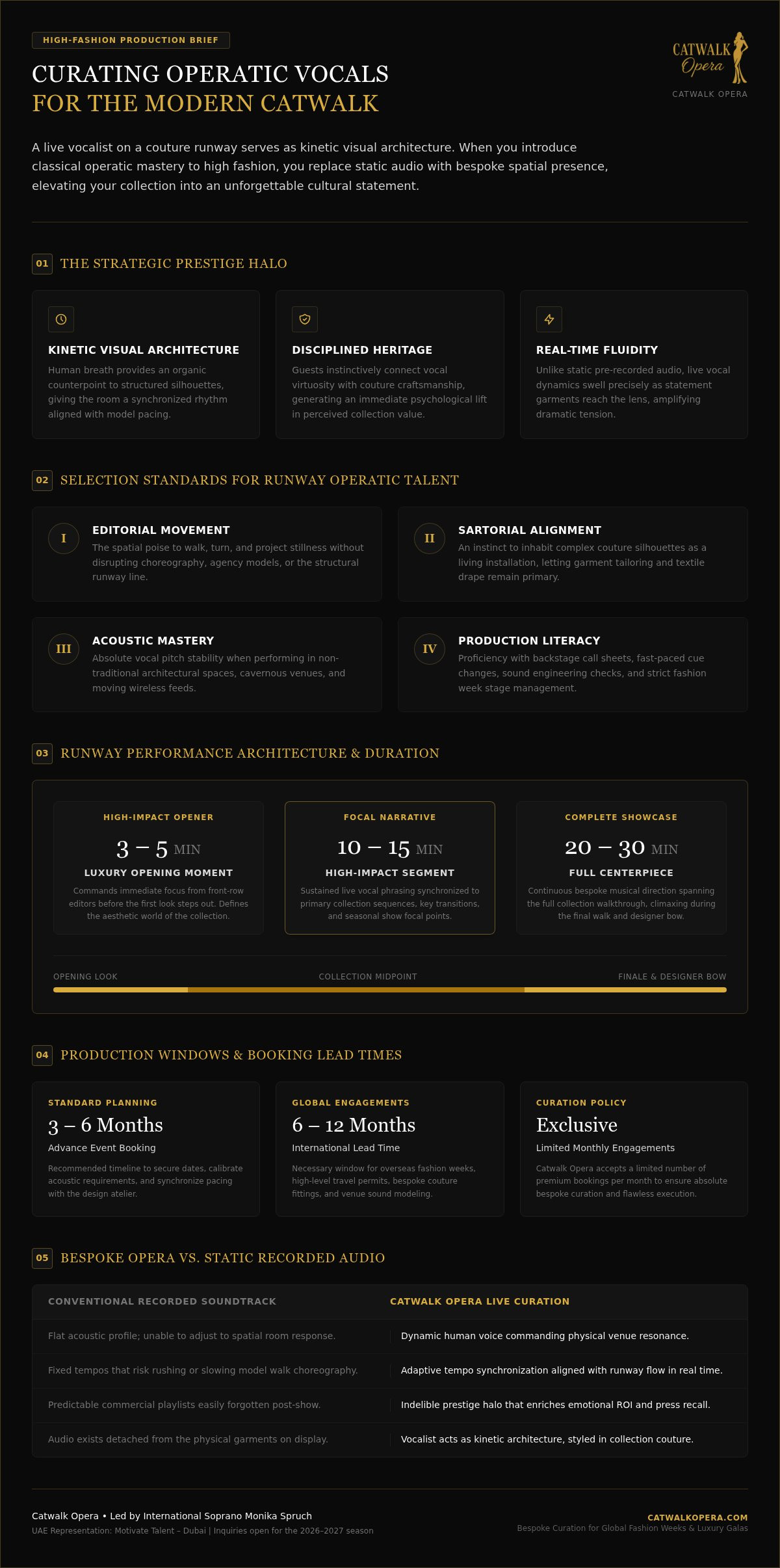
Modern runway presentations have outgrown conventional production formulas. A curated live vocal presence transforms a seasonal line from a commercial preview into an indelible cultural statement. Integrating an opera singer for fashion show environments introduces an acoustic dimension that pre-recorded sound cannot replicate. The visceral resonance of a classical voice commands the space, producing an immediate physical response across your front row.
Human breath introduces an organic counterpoint to structured textile movement. As models advance in sharply tailored wools, structured corsetry, or fluid silks, live vocal phrasing gives the entire room a shared kinetic rhythm. The result is pure theatre that lingers in the memory of critics and clients long after the final exit.
The Psychology of the Prestige Halo
Operatic performance carries immediate associations with heritage, disciplined craft, and exclusivity. To appreciate why it resonates so deeply in high-fashion environments, consider what opera is: an centuries-old discipline grounded in acoustic power, refined technique, and narrative grandeur. When this discipline intersects with couture, guests draw an unconscious link between the vocal mastery in the air and the sartorial craftsmanship on the catwalk.
This dynamic builds an elevated prestige halo. Elite attendees, seasoned editors, and private buyers discern the rarity of live execution. A dynamic human voice directly enhances the perceived value of your collection, signaling that the presentation represents the pinnacle of artistic expression.
Beyond Static Playlists and Digital Audio
Standard recorded soundtracks often flatten a room. They remain static, unable to adapt to the ambient energy of the venue or the visual tension of a runway finale. In contrast, an opera singer for fashion show catwalks responds to the visual pacing of the presentation in real time. Live crescendos can swell precisely as a statement look reaches the photographers, magnifying dramatic impact without feeling artificial or mechanical.
Curating an elevated fashion opera performance replaces standard background audio with bespoke artistic collaboration. By weaving vocal dynamics directly into your collection narrative, you create an intimate, arresting atmosphere that commands absolute attention from the opening look to the designer bow.
Essential Criteria for Selecting an Operatic Vocalist
Selecting an opera singer for fashion show stages requires looking beyond vocal brilliance. A traditional concert artist used to static proscenium halls may struggle with the kinetic demands of a runway. Catwalks require disciplined physical poise, spatial awareness, and a natural editorial ease that matches working agency models.
When curating a soprano for your presentation, evaluate these core standards:
- Editorial movement: The ability to walk, turn, and project stillness without disrupting the choreography of the model line.
- Sartorial alignment: An instinctive understanding of how to inhabit bespoke couture silhouettes and move within complex garments.
- Acoustic control: Absolute pitch stability when navigating non-traditional runway spaces and shifting wireless audio feeds.
- Production literacy: Deep familiarity with backstage call sheets, rapid cue adjustments, and high-pressure fashion week timelines.
Runway Poise and High-Fashion Sensibility
An operatic performer on the catwalk functions as part of the visual staging. She must share the runway with models without competing for attention, embodying the narrative mood of the collection. The intersection of opera and high fashion thrives because both mediums celebrate dramatic proportion and artisanal craftsmanship.
When styled in your garments, the singer becomes a living installation. She commands respect through controlled, sculptural posture, allowing the textile drape and tailoring to take center stage alongside the score.
Vocal Versatility and Contemporary Arrangements
Runway shows operate at a brisk tempo. Purist opera scores often move too slowly for rapid model turns, which makes crossover versatility essential. A seasoned opera singer for fashion show productions easily bridges traditional bel canto technique with minimalist synths, driving percussion, or ambient electronic beds.
Engaging an experienced luxury opening act performer allows you to seize guest attention within the first ninety seconds of the show. If you are developing your next seasonal presentation, exploring bespoke curation with Catwalk Opera ensures that both staging and sound align effortlessly with your creative vision.
Synchronizing Live Repertoire with Collection Narratives
Bridging high fashion with operatic repertoire requires exact rhythmic synergy. When musical pacing drags, models lose their stride; when it rushes, structured textiles lose their intended movement. A seasoned opera singer for fashion show productions collaborates directly with your sound designer to align vocal phrasing with catwalk pacing.
Repertoire selection must mirror your collection’s architectural silhouette:
- Structured tailoring: Clean, neoclassical phrasing or sharp Baroque passages that reflect sharp lapels and linear cuts.
- Romantic drape and volume: Expansive, soaring verismo arias that carry the visual weight of tulle, organza, and flowing trains.
- Avant-garde designs: Hypnotic crossover compositions layered over ambient electronic frequencies.
Achieving this balance demands advanced technical and artistic skills, ensuring live acoustic delivery blends seamlessly into venue sound without overpowering subtle garment details.
Matching Tempo to Catwalk Choreography
Runway choreography typically operates at an internal cadence of 110 to 125 beats per minute. The vocalist must maintain this rhythmic pulse while preserving the emotional breadth of classical phrasing. Precise musical rests allow dramatic looks to pause at the runway apex in absolute visual focus. Controlled vocal builds then propel the model back toward backstage, generating natural momentum before the head designer’s final walk.
Curation Formats from Openings to Full Centerpieces
Runway programming dictates how musical pieces fit into your overall event flow. Aligning vocal staging with collection scope requires choosing an appropriate structural format:
- Luxury Opening Moment (3 to 5 minutes): A single, high-intensity aria that commands immediate silence, centers attendee focus, and introduces the first look.
- High-Impact Interludes (10 to 15 minutes): Melodic transitions between distinct capsule groupings, offering an acoustic palate cleanser between dramatic color shifts.
- Full Runway Centerpiece (20 to 30 minutes): An unbroken live soundscape accompanying the entire presentation, from opening silhouette to final promenade.
Selecting the right structure guarantees that an opera singer for fashion show runways complements your pacing while keeping the focus squarely on the garments.
Technical Production and Acoustic Mastery for Runways
Runway presentations rarely occupy acoustically treated auditoriums. Designers routinely favor converted industrial warehouses, dramatic glass atriums, historic palazzos, or custom temporary tents. While visually arresting, these environments present severe sonic obstacles. Integrating an opera singer for fashion show staging requires meticulous audio engineering to ensure vocal purity without compromising the clean visual sightlines of the room.
Balancing live vocal projection against challenging architecture requires strict technical planning:
- Venue calibration: Tuning output frequencies to counter hard concrete reflections and high ceilings.
- Radio frequency management: Securing protected wireless channels free from media camera rigs and backstage communication feeds.
- In-ear monitor isolation: Providing the vocalist with zero-latency audio to maintain pitch across long, echo-prone catwalk layouts.
- Closed technical rehearsals: Running exhaustive acoustic checks hours before editors, buyers, and VIP guests arrive.
Managing Challenging Venue Acoustics
Reflective glass partitions and bare floors cause sound waves to bounce unpredictably, muddying classical high notes. Professional sound engineers resolve this by deploying distributed line-array speakers positioned along the seating risers rather than blasting high output from a single source. This distributed approach guarantees that every guest experiences clear, immediate vocal resonance without acoustic distortion.
Aesthetic Sound Equipment and Discreet Mic Placement
Visual purity on the runway is non-negotiable. Bulky handheld microphones and awkward transmitter belts disrupt garment silhouettes and compromise editorial photography. Premium productions rely on miniature omnidirectional capsules positioned discreetly along the hairline, paired with customized transmitters concealed within couture linings.
Coordinating stage lighting with the audio path ensures follow-spots highlight both the vocalist’s movement and delicate textile details. When staging an opera singer for fashion show runways, technical precision must match visual ambition. To ensure your venue acoustics and staging integrate flawlessly, consult with Catwalk Opera ahead of your seasonal production schedule.
Engaging Catwalk Opera for Global Fashion Week Presentations
Standard casting calls rarely yield a vocalist prepared for the relentless tempo of a major fashion week. Catwalk Opera, led by internationally acclaimed soprano Monika Spruch, was conceived specifically to bridge this gap. By uniting classical mastery with editorial runway staging, the concept offers fashion directors a bespoke alternative to generic audio licensing and session vocalists.
Catwalk Opera accepts a limited number of premium bookings per month. This deliberate selectivity guarantees absolute dedication to each collection, ensuring seamless aesthetic synergy across the fashion capitals of Paris, Milan, London, and New York.
The Bespoke Artistic Process with Monika Spruch
True creative synergy begins long before the house lights dim. Monika Spruch collaborates directly with designers and show directors, beginning with initial mood boards and fabric swatches, continuing through fitting consultations, and concluding with final dress rehearsals.
Rather than standing apart, she inhabits the designer’s aesthetic, wearing runway garments with the natural posture and movement of an editorial model. Her extensive international background performing at high-profile luxury galas and exclusive private recitals brings distinguished authority to your brand presentation.
Lead Times and Production Coordination
Securing an experienced opera singer for fashion show presentations requires careful scheduling around the international fashion calendar. For domestic runway shows, we recommend securing your booking at least three to six months in advance to allow ample time for custom musical arrangements and wardrobe fittings.
For international presentations requiring artist travel, foreign logistics, and dedicated coordination, a lead time of six to twelve months is recommended. Global availability is currently open for the 2026 season, whether you are planning a focused three to five minute Luxury Opening Moment or the complete Signature Fashion Opera Experience. To reserve your dates and begin shaping your runway presentation, connect directly with Catwalk Opera.
Elevating Your Next Runway Into an Unforgettable Cultural Statement
A transcendent fashion show requires more than exquisite garments; it requires an acoustic identity that magnifies your design philosophy. Selecting the right opera singer for fashion show presentations unites kinetic catwalk poise with refined classical technique, establishing an immediate prestige halo around your collection. Flawless tempo synchronization, discreet audio integration, and couture styling ensure that live vocals elevate the runway without ever competing against the silhouettes.
Conceived by internationally acclaimed soprano Monika Spruch, Catwalk Opera bridges classical virtuosity with the rigorous demands of modern runway staging. Drawing on extensive experience across international fashion weeks, royal recitals, and luxury galas, each presentation is tailored to your creative narrative, from focused three-minute opening moments to immersive thirty-minute centerpieces. Inquire with Catwalk Opera to curate a bespoke runway performance and craft a breathtaking, emotionally resonant centerpiece for your 2026 collection debut.
Frequently Asked Questions
How does an opera singer for fashion show events coordinate tempo with runway models?
An opera singer for fashion show productions coordinates directly with show callers and sound designers to anchor phrasing around an established walking tempo, usually between 110 and 125 beats per minute. Rehearsals ensure vocal cadences complement model steps and apex poses without dragging. Real-time adjustments allow the vocalist to react to model spacing, ensuring the music never speeds up or slows down the runway line.
Can an operatic soprano wear garments from the designer collection during the presentation?
Yes, styling the vocalist in the designer’s collection is standard practice and enhances the presentation’s cohesive aesthetic. Fittings take place during show preparation to ensure the garments accommodate proper diaphragm expansion and unrestricted breath control. By wearing pieces from the runway collection, the soprano becomes a kinetic extension of the designer’s creative vision rather than an external observer.
What technical sound equipment is required to support live opera in an unconventional fashion space?
Producing pristine live vocals in raw industrial spaces or open atriums requires specialized acoustic planning. Essential gear includes miniature wireless condenser microphones discreetly integrated into hair or couture garments, low-latency in-ear monitoring systems, and distributed audio arrays. This setup isolates the vocalist from natural venue flutter echoes while delivering clean, immersive vocal presence to front-row attendees without visible cable clutter.
How far in advance should luxury brands reserve an opera singer for international fashion weeks?
We recommend reserving your performance three to six months in advance for domestic presentations. For international fashion week schedules involving travel to Paris, Milan, London, or New York, securing dates six to twelve months ahead is strongly advised. Because Catwalk Opera accepts a limited number of premium bookings per month, early engagement guarantees full alignment with your creative calendar and production deadlines.
What duration options exist for integrating live vocals into a fashion show schedule?
Runway formats typically fall into three distinct structures depending on your event flow. A Luxury Opening Moment spans three to five minutes to command guest attention for the initial silhouette. High-impact interludes last ten to fifteen minutes to support mid-collection transitions. For grand galas and extended presentations, an uninterrupted twenty to thirty minute centerpiece carries the audience through the final designer walk.
How do classical crossover vocals compare to traditional operatic arias on the catwalk?
Traditional arias deliver pure heritage and raw dramatic power, making them ideal for dramatic couture reveals. Classical crossover arrangements, by contrast, combine bel canto vocal control with contemporary electronic beats, ambient soundscapes, or rhythmic syncopation. This versatility allows an opera singer for fashion show stages to match the quicker tempo of commercial collections while maintaining an elevated classical tone.
Does Catwalk Opera perform internationally for couture shows and private designer salons?
Yes, Catwalk Opera performs worldwide, supporting haute couture presentations, fashion week runway events, luxury galas, and private royal recitals. Led by international soprano Monika Spruch, the concept provides bespoke staging, customized musical arrangements, and complete production coordination across the globe. Global availability is currently open for the 2026 and 2027 seasons across major fashion capitals and private international venues.