What if the most elegant party soundtrack is defined less by genre than by the way each musical moment arrives? Music selection for a sophisticated party calls for more than a polished playlist: it should reflect your guests, complement the setting and move gracefully with the evening. Even beautiful music can feel misplaced if it competes with conversation or overshadows a welcome, dinner or defining moment.
The art lies in creating a considered progression, balancing familiar melodies with classical elegance and contemporary sounds, then adjusting the energy as the event unfolds. In this guide, you’ll discover how to shape that musical journey around your event’s character, support conversation and key transitions, and create an atmosphere that feels cohesive rather than generic. You’ll also explore when bespoke live vocal artistry can become a distinctive focal moment. Led by international soprano Monika Spruch, Catwalk Opera brings operatic artistry and cinematic presence to luxury events, connecting the music with the evening’s visual identity. The result is a soundtrack that does more than fill the room: it gives the occasion its own refined character.
Key Takeaways
- Make music selection for a sophisticated party purposeful by defining whether the music should welcome guests, encourage conversation, express a brand, or create a memorable focal moment.
- Map the evening’s key moments before choosing musical character, then review transitions so each shift feels intentional.
- Let the room and visual design inform the sound, while keeping the event’s identity at the centre of your choices.
- Compare recorded music and live artistry by their role: one can sustain an atmosphere, while the other can command attention at a defining moment.
- Discover how Catwalk Opera’s bespoke live vocal artistry, led by international soprano Monika Spruch, can bring a distinctive performance moment into your event plan.
What Makes Music Selection for a Sophisticated Party Feel Truly Considered?
Considered music supports a gathering’s character, not simply its volume. It reflects why guests have come together, how the setting should feel and what role sound should play in each moment. For a host, music selection for a sophisticated party begins with the event objective: welcoming guests, encouraging conversation, celebrating an occasion, expressing a brand or creating a memorable focal moment.
Music shapes atmosphere, guest experience and event purpose in a single, carefully judged gesture. That does not require every choice to be solemn or formal. Sophistication can feel warm and inviting, with a sense of ease, while still being polished. A private celebration may call for intimacy and personal meaning; a luxury gala may express a more ceremonial character. In either case, refinement comes from fit, not from formality alone.
How the event objective shapes the musical mood
Before choosing a genre, picture the guest experience across three points: arrival, conversation and the evening’s defining moment. Ask what guests should feel as they enter, whether the music should sit discreetly beneath conversation, and what emotional impression the central moment should leave. These answers establish a purpose for each musical choice, rather than relying on a list of attractive tracks without a clear relationship to the occasion.
Plan around event flow, the sequence and timing of activities during a gathering. If guests arrive before a welcome or formal address, the music can create anticipation without competing with either. A celebration centred on a personal milestone may favour warmth, while a brand event can use a more distinctive musical character to express its identity. The objective gives each transition a reason.
Why guest expectations matter as much as genre
Your guests bring expectations shaped by the occasion, cultural context and their own listening habits. Consider whether the gathering is intimate or ceremonial, whether guests will know one another well, and whether music is expected to invite participation or remain a subtle layer. These details can guide choices more precisely than selecting a genre simply because it is traditionally associated with elegance.
A thoughtful balance can pair recognisable melodies with less expected selections, allowing the sound to feel welcoming yet individual. Familiarity can give guests an easy point of connection; a carefully chosen contrast can add character and make the evening feel personal. Classical music may suit a particular setting or moment, but sophistication does not depend on using it exclusively. Contemporary or crossover sounds can also feel refined when they align with the occasion, audience and intended mood.
Use these prompts to clarify your brief before making selections:
- Purpose: What should the music achieve for guests or the host?
- Audience: What tone will feel appropriate to their expectations and the occasion?
- Prominence: Should sound recede during conversation or draw attention at a focal moment?
- Character: Which familiar and unexpected elements express the gathering with distinction?
When these decisions are clear, the music has a coherent role within the occasion. The result can be polished without feeling distant, and memorable without overwhelming the people and purpose at its centre.
How to Curate Music Around Atmosphere, Setting, and Event Flow
A considered music plan is built in sequence, not assembled as a collection of attractive selections. For music selection for a sophisticated party, your setting, visual identity and schedule should inform the choices, while leaving room for musical character to bring its own artistry. Treat the soundtrack as part of the occasion’s design: it can shape how a room feels, signal a change in pace and give a defining moment its own presence.
Use this four-step framework to turn the event objective into a practical plan:
- Define the objective. Decide what music should contribute: a gracious welcome, ease during conversation, a celebratory lift or a moment that expresses the host’s or brand’s identity.
- Map event moments. Set out the guest journey from arrival through the main gathering and closing. Mark scheduled remarks, entrances and other moments when attention needs to shift.
- Select musical character. Choose sounds that suit each moment and the overall tone, rather than applying one mood uniformly throughout the evening.
- Review transitions. Consider how one section gives way to the next. Check that changes in pace or prominence feel connected to the host’s priorities and the planned sequence.
Sequencing makes music feel intentional because each change has a place in the evening’s story.
Build a music plan around the event sequence
Start with guest arrival, when music can establish the first impression; then plan the main gathering, where it may recede to make conversation comfortable. Identify transitions that call for a shift in character, and decide whether a focal performance belongs at a particular point. The closing can return to a quieter or more celebratory tone, depending on how you want guests to leave. Mark these choices beside the event schedule so the music supports, rather than competes with, its priorities.
Match musical character to the room and visual identity
Read the space and design as cues, not instructions. A generous ballroom, intimate residence or fashion-led setting may each suggest a different sense of scale and presence. Consider the décor, palette, lighting and wardrobe direction, then choose music that complements the visual language without simply mirroring it. A restrained setting might welcome a more expressive musical contrast; a dramatic design may call for a measured sound that lets its details remain in focus.
In an intimate home, residential acoustics can influence how a live voice is perceived, so the room itself belongs in the planning conversation. Beyond the setting, consider the event’s sound alongside its other sensory elements: lighting, movement, staging and the rhythm of service. AGNT’s guidance on corporate event music choices also considers how musical styles can suit an event’s character.
If your plan calls for a live focal moment, explore how bespoke live vocal artistry can connect the musical sequence with the event’s visual identity.
Live Performance or Playlist: Which Suits a Sophisticated Party?
A playlist and a live performance serve different purposes, so your decision need not be an either-or choice. Recorded music can sustain a consistent atmosphere across arrivals, dining and conversation. Live vocal artistry brings a visible, human presence that can draw guests into a distinct moment. For music selection for a sophisticated party, consider what each format should contribute to the gathering, then place it where it can best serve the occasion.
Presence: Recorded music creates an audible atmosphere; live artistry adds a performer and a visual focal point.
Adaptability: A playlist offers continuity through planned selections. A live performance can be tailored to a specific moment and its role in the event.
Event role: Use recorded music to support the broader gathering, or live vocals to mark an opening, celebration or brand expression.
Relationship to conversation: Recorded music can sit discreetly beneath conversation. Live artistry invites attention, making placement and timing central to its impact.
When a curated playlist supports the gathering
A thoughtfully assembled playlist is well suited to moments that benefit from musical continuity, such as guest arrival, dining or informal conversation. Track choices can reflect the host’s intended character, while a considered sequence gives the atmosphere shape without making the music the centre of attention. Its limitation is presence: recorded sound can maintain a mood, but it does not create the same visible focal moment as a live performance.
When live vocal artistry becomes part of the occasion
Live vocals can turn a planned interval into a cultural statement, connecting artistry with the occasion’s visual identity. If you worry that opera may feel too formal, think beyond genre: a concise performance, placed with purpose and styled to suit the setting, can feel cinematic and contemporary rather than ceremonial. A Luxury Opening Moment lasts 3 to 5 minutes, offering a defined opening gesture. A longer centerpiece gives the performance a more prominent role in the evening.
The distinction is one of scale and event function. A short opening can signal a transition or establish the mood, while a centerpiece asks guests to give the performance greater attention. Catwalk Opera’s bespoke fashion opera performance connects live vocal artistry with high-fashion presentation, bringing a considered visual dimension to a luxury event.
You can also combine formats: let a curated playlist carry the surrounding moments, then introduce live artistry at the point where the event calls for a focal presence. This approach keeps conversation and continuity in view while giving a defining moment its own identity.
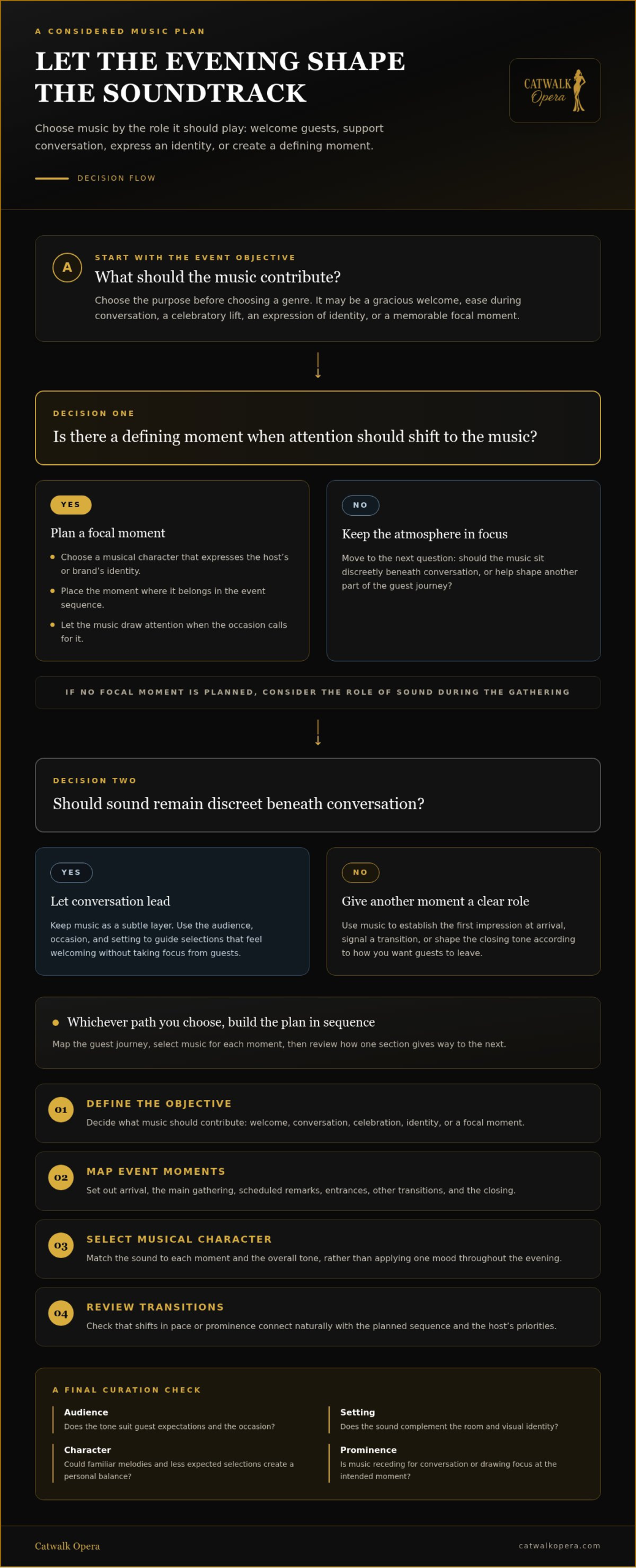
How to Plan Music for Arrival, Conversation, and a Defining Moment
A strong music plan gives each part of the evening a clear role. For music selection for a sophisticated party, map the sound to the host’s programme, visual design and event flow, then decide when music should remain discreet and when it should come forward. The sequence can change in prominence while retaining a consistent identity through a shared musical character, mood or relationship to the occasion.
Use this checklist as you review the schedule with your event team:
- Arrival: Choose music that welcomes guests and introduces the evening’s character. Consider what they see as they enter, so the first impression feels composed rather than incidental.
- Conversation: Keep music supportive during cocktails or dining. It should accompany the exchange of conversation, not ask guests to divide their attention between talking and listening.
- Transitions: Mark moments when the programme changes, such as a welcome, a move between spaces or the start of a meal. Decide whether music should signal the change or allow it to pass quietly.
- Focal moment: Choose a performance or musical shift only when it serves the event objective. Coordinate its timing with speeches, entrances and the visual presentation.
- Closing: Decide whether the final musical character should echo the opening, create a sense of celebration or offer a more intimate close.
Set the tone without competing with conversation
Arrival music can establish a welcoming mood while guests orient themselves and greet one another. As conversation becomes the focus, let the music take a supporting role; the desired effect is a graceful atmosphere, not a competing performance. Coordinate selections with the room’s visual language and the host’s programme, so the sound remains connected to the event even as its prominence recedes.
Create a memorable transition or focal moment
A live moment is most effective when it has a clear purpose, such as opening a luxury gala, marking a reveal or expressing a brand’s identity. Align its placement with the programme and visual presentation, including the entrance or staging, so guests understand where to direct their attention. For a live vocal performance, the luxury event soprano guide offers further planning context.
Consider emotional ROI, the lasting emotional impact and shared memories created by live artistry. A performance chosen for a precise moment can give the gathering a distinctive memory, while the surrounding music continues to serve the wider evening. The contrast is purposeful: attentive listening at the focal point, then a return to the event’s broader rhythm.
If a live vocal moment would give your programme a distinctive centrepiece, plan a bespoke performance with Catwalk Opera.
How Catwalk Opera Can Shape a Bespoke Musical Moment
Catwalk Opera brings live vocal artistry into a wider music plan as a distinctive centrepiece, rather than asking recorded selections to carry every part of the occasion. For music selection for a sophisticated party, bespoke curation can connect operatic elegance and cinematic presence with the event’s purpose and visual identity, while allowing the surrounding music to support the rest of the evening.
A live performance shaped around your event’s character
Curation begins with the occasion: its atmosphere, audience and intended cultural statement. Rather than relying on stock-licensed music alone, you can shape a live artistic moment around the gathering’s character and design language. A concise opening performance can establish a sense of occasion, while a more prominent centerpiece can invite guests to give the artistry their full attention. The choice depends on the role you want music to play.
This approach allows live performance to complement, rather than dominate, a party. Recorded music can support the surrounding moments, while a soprano’s presence creates a defined point of focus. At a fashion-led event, the performance can relate to the visual presentation; at a private gathering, it can lend a meaningful occasion an elevated, personal quality. In each case, the musical moment is tailored to the event, not imposed on it.
From musical idea to a considered event moment
Begin with a clear brief. Identify the event objective, the moment music should support and how it relates to the programme and visual design. Is the performance intended to welcome guests, open a key segment or create a dramatic pause before the next part of the evening? A precise purpose helps you place live artistry within the broader sequence, leaving other musical choices to sustain the atmosphere around it.
Catwalk Opera brings an international perspective to prestigious private, corporate and fashion occasions. Its approach pairs operatic artistry with high-fashion presentation, allowing performance to contribute to the event’s visual language as well as its sound. This can be especially meaningful when you want music to express a point of view, rather than simply fill a silence.
For an event-defining opening, explore how a luxury opening act performer can align live artistry with your programme and presentation. If you are considering a tailored performance, you can enquire about a bespoke musical moment shaped around your event’s character.
Give Your Event a Distinctive Musical Signature
As you move from planning to creative direction, consider the musical impression you want guests to carry with them after the evening ends. A clear brief can help: describe the feeling you want to create, the character of the setting and the role music should play in expressing the occasion. This gives your choices a point of view, whether your gathering is intimate, celebratory or designed to make a statement.
Thoughtful music selection for a sophisticated party is not about following a fixed formula. It is an opportunity to shape an experience that feels unmistakably yours, with every artistic element in conversation with the event’s identity. A bespoke live moment can bring that vision into focus through the presence of an internationally acclaimed soprano and the expressive quality of operatic artistry.
Let your event’s creative direction guide the next step. Explore a bespoke live performance for your event and begin shaping a musical signature your guests will remember.
Frequently Asked Questions
Is classical music always the right choice for a sophisticated party?
No. Classical music is not essential to an elegant gathering. If you are weighing different styles, consider how they will sit alongside the event’s dress code, setting and guest mix. For example, a contemporary selection can feel at home at a fashion-forward reception, while a classical passage may provide a graceful counterpoint. Choose with the evening’s character in mind, rather than treating a genre as a shortcut to sophistication.
Can a live soprano performance work at a private celebration?
Yes. A live soprano performance can suit a private celebration when there is a natural moment for guests to turn their attention to the artistry. A milestone toast or an anniversary greeting may provide that focus without making the performance feel detached from the occasion. Consider how guests will gather and whether the moment should feel intimate or ceremonial. Catwalk Opera tailors live vocal experiences to the character of luxury events.
How loud should music be during a dinner party?
There is no universal volume setting for a dinner party. As a practical guide, choose music that allows guests at opposite ends of the table to speak without repeatedly raising their voices. If a speech or toast is planned, leave a clear pause for it rather than expecting guests to listen over music. The aim is ease at the table, with sound complementing the meal rather than becoming its principal focus.
Does sophisticated party music need to be live?
No. Recorded music can be entirely suitable, particularly if you want a consistent sound without directing attention to a performer. Live music is an option when you want to give a selected moment a human presence. It can also help anchor a programme if timings shift: recorded selections can bridge a delay, while a live performance can remain reserved for its planned place. Choose the format according to the role you need it to fulfil.
What is a pop opera performance?
A pop opera performance combines traditional operatic singing with contemporary crossover elements. It can be a considered choice for guests with varied musical tastes, offering a meeting point between classical vocal artistry and a modern aesthetic. Before selecting this style, think about how its character will sit alongside the event’s visual direction and the mood you want to create. It should feel integral to the gathering, not included simply because it is unexpected.
How far in advance should I book an international soprano?
Catwalk Opera recommends securing a booking at least three to six months before the event, and advises allowing six to twelve months for international luxury events. The international visa timeline, the period required to secure work permits for artists traveling abroad for performances, can affect preparations. Early planning gives you more room to coordinate the performance with travel arrangements, the event schedule and the creative direction of the occasion.