A bespoke show is shaped by the collaboration behind it as much as by the moment guests see on stage. To understand how to collaborate with an artist for a bespoke show, agree from the outset on roles, creative direction, schedule, resources and intended outcome. Clear expectations give artistry room to flourish while keeping the event’s vision in focus.
For a fashion presentation or luxury gathering, the strongest partnership brings distinct creative perspectives together in harmony with the collection, setting and event flow. You may already have a visual concept or a particular atmosphere in mind; translating it into a well-coordinated performance takes thoughtful communication and practical planning. This guide explains how to shape the brief, divide responsibilities, plan timing and resources, and define how the finished work will be used. It also explores the creative exchange and brand value that can emerge when artistic disciplines meet with a shared purpose.
Key Takeaways
- Set a shared creative objective, assign responsibilities, and record deliverables, timelines, payment, and usage rights before work begins.
- Choose an artistic partner whose values and audience suit the brand, while bringing a complementary perspective to the collaboration.
- Build in regular conversations and room for each artist to influence the work, so the final piece feels genuinely co-created.
- For fashion and luxury projects, connect the creative concept to the collection, event setting, and desired impression on guests.
- Clarify how the finished work will be presented or handled, then consider whether a bespoke live performance could create the desired opening moment.
1. Agreeing on roles, time, supplies, and project outcomes
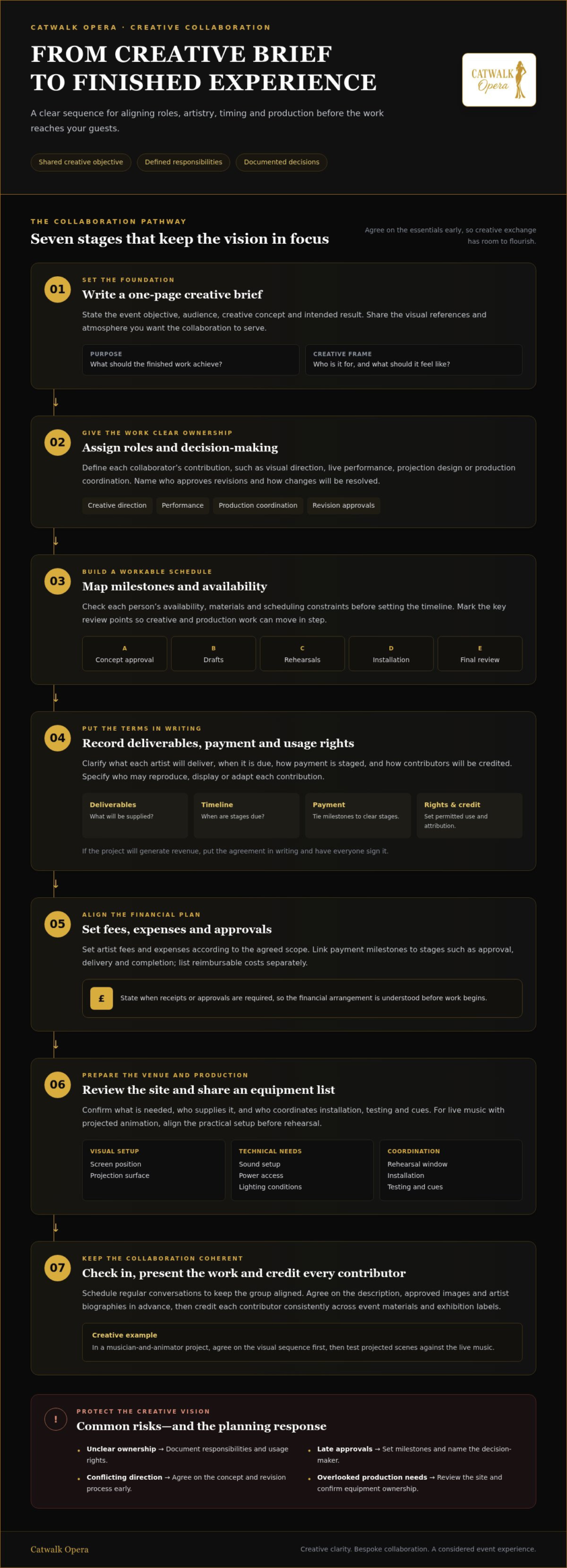
Begin with a one-page brief outlining the event objective, audience, creative concept and intended result. Give each collaborator a defined role, such as visual direction, live performance, projection design or production coordination. For a guest artist exhibition, specify who selects the works, prepares display materials and speaks with guests. Note each person’s availability, materials and scheduling constraints before agreeing on a timeline.
Set milestones for concept approval, drafts, rehearsals, installation and final review. A musician and animator might first agree on the visual sequence, then test projected scenes against live music. Brian Gore and illustrator Bill Russell’s The Wine Country pairs projected animated stories with coordinated guitar compositions. Their example shows why collaborators should explain the concept simply and share creative references early.
For contracts and intellectual property, record the deliverables, timeline, payment, usage rights and how each artist will be credited. If the project will generate revenue, put the agreement in writing and have everyone sign it. Clarify who may reproduce, display or adapt each contribution.
Set artist fees and expenses according to the agreed scope, with payment milestones tied to clear stages such as approval, delivery and completion. List reimbursable expenses separately and state when receipts or approvals are required. This gives everyone a clear understanding of the financial arrangement before work begins.
Plan technical, venue and production requirements with a site review and a shared equipment list. For live music with projected animation, establish the screen position, projection surface, sound setup, power access, lighting conditions and rehearsal window. Confirm who supplies each item and who coordinates installation, testing and cues.
Common commissioning risks include unclear ownership, late approvals, conflicting artistic direction and overlooked production needs. Reduce these risks by documenting responsibilities, naming a decision-maker for revisions, scheduling check-ins and agreeing on how to resolve changes before final delivery.
Promote the collaboration with a concise description of the shared concept, approved images, and each artist’s preferred biography. Agree on the wording and timing in advance, then credit every contributor consistently across event materials and exhibition labels. For a community art project involving 100 people, appoint a coordinator to organize participation, materials, and communication; regular updates help keep the group aligned.
To organise the project, artists should state their desired outcomes, intended roles, available materials and time, and scheduling constraints before beginning. A filmmaker and painter can develop visuals for a short film, animation or projection; a musician and visual artist can create music inspired by the artist’s work or make art to live music. Two artists might collaborate in a live performance, with one creating art as the other performs, or combine a three-dimensional sculpture with digital projections mapped onto it.
2. Benefits of artist-brand partnerships
An artist-brand partnership can give a campaign a distinctive visual language while introducing the artwork to a new audience. The strongest results offer value to both sides: the brand gains an expressive cultural statement, and the artist gains a context that supports their practice. For an event planner, this exchange can turn a launch or runway moment into an experience guests remember beyond the event itself.
Partnerships can take several forms. An artist might create campaign imagery, contribute a design to a limited-edition product, reinterpret a brand motif or make work for a live activation. A design house might invite an artist to respond to its materials, silhouettes or visual codes. Choose a format that suits the audience and the artist’s practice, rather than treating the artwork as decoration added after the concept is set.
Louis Vuitton’s collaboration with Takashi Murakami illustrates how a design brand and an artist can reframe familiar visual codes. Their partnership began in 2002, and Murakami reimagined the monogram in 33 shades in 2003. The example demonstrates a creative opportunity: a recognisable brand identity can become a new artistic canvas while remaining visibly connected to its source. A collaboration does not need to imitate this scale; a focused event activation can also make the relationship legible to guests.
Before approaching a brand, research its stated values, public work and audience. Review recent campaigns, product design and cultural partnerships, then consider whether your artwork belongs naturally in that setting. A shared interest in craftsmanship, material experimentation or heritage offers a credible starting point. A mismatch can weaken both the brand message and the artist’s relationship with their existing audience.
Use a short alignment test before proposing an idea:
- Values: Can you connect the brand’s identity with the themes in the work?
- Audience: Would the brand’s customers understand and engage with the artistic approach?
- Contribution: Is the artist’s role distinctive, rather than a decorative afterthought?
- Outcome: Does the collaboration serve a clear campaign, product, or event objective?
LEGO’s 2021 recreation of Robert Indiana’s LOVE artwork for its LEGO Art series offers another example of translating an established work into a design product. For a fashion presentation, the same principle can inform a partnership between a designer’s collection and a complementary artistic medium. Align the concept, audience, and format first; that foundation makes the collaboration feel considered, culturally relevant, and lasting.
3. Mutual exchange of ideas and perspectives
A fruitful exchange begins when both collaborators bring a clear point of view and remain open to change. For a fashion event, you might share the collection’s visual references, while an artist responds through a distinct medium or interpretation. The aim is not to make both contributions identical, but to develop a shared vision that gives each perspective room to shape the final experience.
Try a creative exercise before confirming the direction: ask each collaborator to bring a reference, a theme and a question about the project. A poet and illustrator, for example, can compare their interpretations of the same subject, then choose images and language that strengthen one another. This exchange surfaces differences early and helps define the project’s purpose without prescribing every detail.
Working side by side can change the work itself. Artists sharing a residency space can discuss ideas as they develop, while a themed sketchbook swap lets each person add a layer to the other’s drawing. Passing unfinished pieces back and forth can invite surprising choices, but agree on the project’s boundaries first. Set a shared theme, clarify who makes the final selection and preserve each collaborator’s distinctive voice.
For an event planner, this process can shape how guests experience the work. A visual artist might interpret a written story through projected imagery, while a performer gives the narrative a live dimension. Rather than treating one discipline as background, agree on how each medium responds to the other. A brief conversation about mood, pacing and audience can connect the artistic idea more closely to the event setting.
Kelly Tunstall and Ferris Plock focus on character design and development in their collaborative work. Their example suggests a practical method: define what the partnership explores, then decide how each artist’s contribution advances that theme. A designer and visual artist might begin with a shared reference board, select recurring motifs and test how those motifs translate across garments, artwork or event visuals. Each review should leave room for new ideas.
Exchange also works across disciplines with different practical demands. A fine artist can create a design for a tattoo artist to translate onto skin; a writer and illustrator can co-create a children’s book. In each case, the collaborators bring different expertise to a shared result. Discuss how the work will be interpreted, which choices remain individual and where joint decisions are needed. These conversations help turn different perspectives into a coherent artistic experience.
Keep the exchange active with scheduled conversations at key creative stages. Share sketches, text or visual references before each meeting, then invite every artist to identify what feels essential and what could evolve. This helps the partnership develop through deliberate choices rather than relying on one person’s vision alone.
4. Art collaborations in fashion and luxury
Fashion collaborations are most compelling when artists’ styles differ but complement each other. A textile designer might create a print, while a fashion designer shapes it into a garment. For a runway presentation, extend that exchange into the setting through art, lighting or live performance. The visual concept should relate to the collection’s mood rather than compete with its silhouettes. That connection helps the collaboration read as a cultural statement, not an accessory.
Start by identifying the design element the artist can reinterpret: a signature motif, material, silhouette or house archive. Then agree on what should remain recognisable and where the artist has freedom to transform it. In a studio meeting, a designer and artist could compare fabric samples with sketches, then assess how the chosen imagery appears from the runway. This practical review connects the creative idea to the physical collection and the audience’s view.
Damien Hirst and Supreme collaborated on a limited-edition set of five skateboards in 2009. The example brings an artist’s visual language into a design object, while connecting it with a distinct brand context. For a luxury brand launch, the equivalent might be an artist’s motif translated into an event installation or campaign visual, where teams like Softmotion produce large-format lenticular prints and immersive installations that bring the artwork to life. The form can change, but the creative relationship should remain clear to the audience.
The BMW Art Car project offers another model of collaboration across disciplines. It began in 1975 when Hervé Poulain invited Alexander Calder to paint a BMW 3.0 CSL for the 24 Hours of Le Mans. The car became a moving canvas, linking the artist’s work with the vehicle’s design and public setting. For your event, consider how an artwork might interact with the runway, venue, or guest journey, instead of appearing as a separate feature.
Julie Mehretu’s BMW Art Car, the series’ 20th, was based on her painting Everywhen. This example shows how a source artwork can guide a new interpretation across formats. You can use the same principle when planning projections, printed elements, or wearable art: identify the original visual idea, then decide how each adaptation serves the collection and event objective. A coherent visual thread gives guests a way to recognise the collaboration across the experience.
For a balanced partnership, agree on creative boundaries before production begins. One artist may lead the visual direction, while the designer determines how the work fits the garment or event environment. Review material, scale, colour and presentation together, then consider how the final result will appear in person and in approved campaign imagery. These decisions protect each artist’s contribution while giving the collaboration a distinct identity.
5. What information should you include in an artist collaboration brief?
A useful brief turns an event concept into a shared creative reference. For a fashion presentation, describe the collection, venue atmosphere, audience and intended impression. Add visual references, such as a palette, fabric detail, architectural feature or campaign image. Explain why those references matter, so the artist can interpret them rather than simply imitate them.
State the event objective and the artist’s contribution directly. For example, a brief might invite a painter to create work inspired by a collection’s sculptural forms, then specify where that work will appear during the event. Distinguish essential elements from optional inspiration. This gives the artist room to develop an original response while keeping the concept connected to the occasion.
Describe the expected deliverables and how the finished work will be handled. Will it be displayed at the event, stored afterward, sold, donated or adapted for another use? Include the intended format and context, such as a physical artwork on a gallery wall or a visual sequence accompanying a live performance. Naming the destination helps collaborators shape the work for its eventual audience.
Give the artist the practical details needed to assess the brief. Identify the venue, access arrangements, event schedule, available materials and relevant production contacts. For projection-based artwork, describe the surface and viewing position. For a garment collaboration, include fabric samples or design drawings. Specific references help the artist understand the project’s scale and visual character.
Use a concise structure to keep the brief easy to review:
- Context: Describe the event, its audience, and the collection or brand story.
- Creative direction: Share references, themes, and the intended atmosphere.
- Contribution: Explain what the artist will create and how it fits the event.
- Presentation: State where and how the work will be experienced.
- After the event: Clarify whether the work will be stored, sold, donated, displayed, or adapted.
Before sharing the brief, review it from the artist’s perspective. Replace phrases such as “make it striking” with an example of the desired mood, material or visual effect. Mark which references are essential and which are open to interpretation. A clear brief guides the collaboration without dictating every creative decision.
If your brief calls for a live, fashion-led performance, you can discuss a bespoke performance concept that connects the artistic direction with the event atmosphere.
Catwalk Opera: Luxury Opening Moment
Catwalk Opera can bring operatic artistry into the visual language of a fashion presentation through its Luxury Opening Moment. This 10-12-minute performance offers a focused opening designed to establish atmosphere and connect the performance with your event’s creative direction. For a more integrated runway concept, the Signature Fashion Opera Experience pairs fashion and live opera in a bespoke presentation.
When the brief calls for a distinctive live performance, Catwalk Opera’s Signature Performance Experiences offer a tailored option. Share your event objective, creative references, venue and preferred place in the event flow to shape the performance direction. For a fashion-led occasion, contact Catwalk Opera to discuss the concept.
Shape the Next Creative Conversation
Your next step is to turn a creative ambition into a clear invitation. Consider what you want guests to feel, what the artist should contribute and how the performance can belong to the event rather than sit beside it. That intention gives your planning a point of view and helps the collaboration develop with purpose. Knowing how to collaborate with an artist for a bespoke show means making space for both your vision and the artist’s interpretation.
For a live operatic element, Catwalk Opera offers the Luxury Opening Moment, Signature Fashion Opera Experience and Private Royal Recital. Each can bring a distinct direction to a fashion presentation, gala or private gathering, shaped around the atmosphere you wish to create.
Begin with the idea you want the evening to leave with your guests, then develop the creative conversation from there. Contact Catwalk Opera to discuss your show and explore a performance concept suited to your event. A considered collaboration can give your vision its own memorable presence.
Frequently Asked Questions
How do you find and choose an artist for a bespoke show?
Choose an artist whose work suits the audience, setting and emotional tone you want to create. Compare portfolios for qualities relevant to your event, such as a strong visual identity, experience with live presentation or fluency across artistic forms. Then consider how the artist’s approach might complement your own. For a fashion event, a performer who understands runway pacing may fit better than an artist whose work is designed solely for a gallery.
How do you develop a concept and creative direction with an artist?
Start with the feeling you want guests to take away, then turn it into a concise creative premise. For example, a collection inspired by light could inform the performance mood, visual palette and transitions between runway segments. A practical approach to how to collaborate with an artist for a bespoke show is to distinguish essential elements from details open to interpretation. This gives the artist a meaningful brief without prescribing every creative choice.
What are the steps and timeline for commissioning a bespoke show?
Commissioning usually moves from an initial concept discussion to a proposal, agreement, creative development, production planning, rehearsal and presentation. The schedule depends on the scale of the work, approval stages, venue access and whether international travel is involved. For a live event, settle the performance’s place in the programme early, then work backward from the event date. This helps align creative decisions with production planning and the wider event schedule.
How do you handle revisions, approvals, and creative disagreements?
Keep revisions focused by linking each comment to the agreed creative direction or a practical event requirement. If feedback differs, ask each collaborator to explain the intention behind their preferred choice, then compare options against the audience experience and event objective. A shared review document keeps comments and decisions visible. Confirm the selected direction in writing before further development, so the artists can proceed with clarity and confidence.