A larger entertainment budget does not automatically deliver a stronger return. There is no universal benchmark for the ROI of live entertainment for corporate events: the right investment depends on your event’s objectives, audience, and production needs.
A live performance can shape the atmosphere and leave a lasting impression, even when its value is harder to measure than ticket sales or leads. A considered budget makes room to assess both measurable outcomes and emotional ROI, without treating one as a substitute for the other.
This guide explains how to set an entertainment budget around your event’s purpose and evaluate returns through brand impact, relationships, staff time, production, and audience engagement. It also shows how a live performance can contribute to the wider event experience, and which measures can help you assess its value after the event.
Key Takeaways
- Set an entertainment budget around the event objective and audience rather than relying on a universal ROI benchmark.
- Assess brand and relationship value through selected measures, combining trackable outcomes with thoughtful judgment.
- Include staff planning and attendance time, along with the opportunity cost of taking people away from other work.
- Match the performance and its production to the event’s tone, schedule, and audience, then assess engagement afterward.
How do you measure the ROI of intangible goals like brand or relationships?
Corporate event entertainment can support brand recall, client relationships, sales conversations, and professional image. Choose a small set of metrics that match your event objective, then record a baseline before the event. Assess measurable outcomes alongside audience sentiment to understand success beyond immediate revenue.
Assessing Intangible Returns
Intangible returns are changes in perception, connection, or conversation that do not immediately appear as revenue. They matter when your event aims to deepen client relationships or strengthen brand affinity. Before the event, choose measures such as message recall, the quality of sales conversations, or follow-up meeting requests. Compare results with your baseline, then consider how the performance contributed to the experience.
Brand Lift and Audience Sentiment
Brand lift is a shift in how attendees recognize or describe your organization after an event. Assess it through consistent questions about brand recall, perceived quality, and sentiment. Send a short survey within 48 hours, while the experience remains fresh, and review responses alongside social reach. For example, compare the event’s posts and audience reactions with your usual brand content, not just total impressions.
Long-Term Brand and Customer Relationships
Some relationship returns emerge through later conversations, renewals, referrals, or new opportunities rather than at the venue. Track qualified event leads and relationship follow-ups for several months after the event. Record whether clients accept meetings, continue discussions, or introduce colleagues. This helps distinguish a memorable evening from a lasting business connection, while grounding attribution in observed interactions.
Brand Perception at Client Events
At a client event, professional image is shaped by the setting, hospitality, and performance together. Consider whether the experience reflects your brand’s intended values and gives clients a natural opening for conversation. Afterward, compare survey comments and message recall with your event objective. A well-aligned performance can contribute to a prestige halo; a mismatch may distract from your business message.
How much should a company spend on corporate event entertainment?
There is no universal ROI benchmark. Set spending according to your event objective, audience, and production needs.
Attendee Memories and Event Engagement
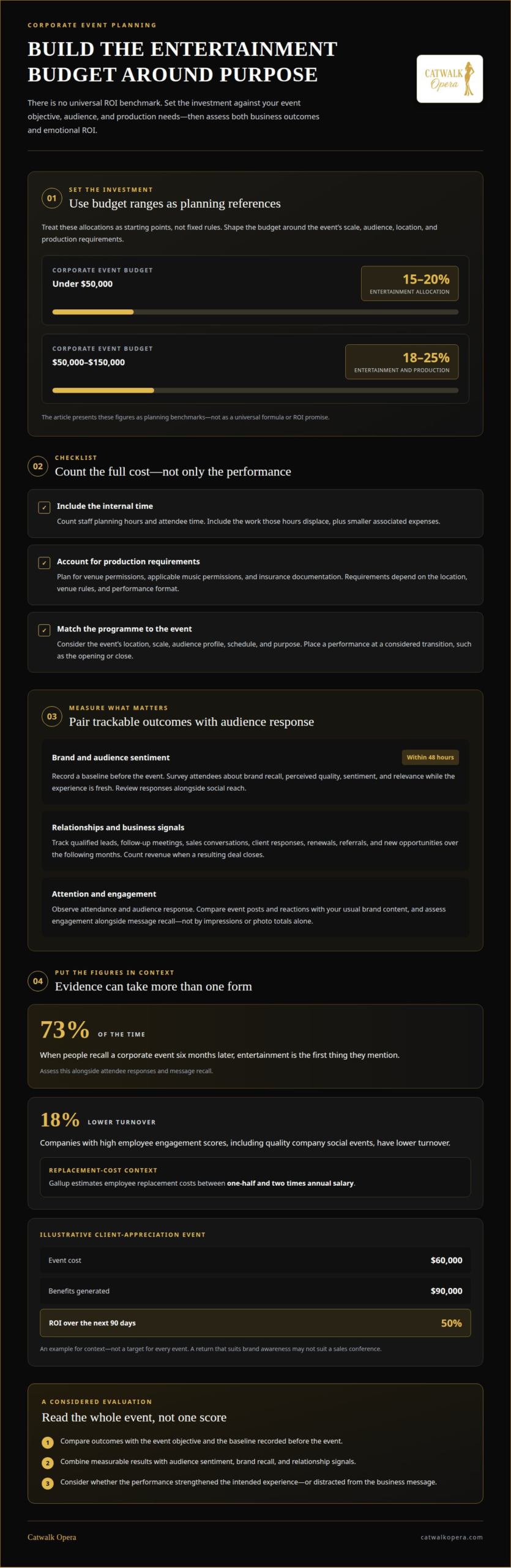
Attendee engagement reflects how guests participate in and remember an event. It matters because a memorable performance can become part of the brand experience. When people recall a corporate event six months later, entertainment is the first thing they mention 73% of the time. A photobooth can capture participation and create shareable images. Evaluate its use alongside attendee responses and message recall, not photo totals alone.
Audience Attention and Focus
Audience attention means guests stay focused on the experience and the event’s purpose. This matters when a live performance is part of a programme with presentations or a sales session. Schedule it at a considered transition, such as the opening or close, and observe attendance and audience response. A well-matched performance can prompt conversation; one that conflicts with the programme may distract from messages guests need to retain.
Post-Event Surveys and Attendee Data
Post-event surveys capture attendees’ impressions while the experience is fresh. Send a concise survey within 48 hours and ask about recall, sentiment, and relevance. Keep responses focused, limit access to collected attendee data, and explain how it will be used. Pair feedback with engagement measures to understand which moments resonated, rather than relying on a single score to represent the entire event.
Performer Requirements and ROI Evidence
Venue, licensing, and insurance requirements depend on the location, venue rules, and performance format. Include venue permissions, applicable music permissions, and insurance documentation in production planning. There is no universal ROI benchmark: a 3:1 return may be excellent for brand awareness yet weak for a sales conference. One illustrative client-appreciation event cost $60,000 and generated $90,000 in benefits, producing 50% ROI over the next 90 days. Treat the example as context, not a target for every event.
Accounting for internal time and opportunity costs
Estimate the total event cost by counting staff planning and attendance time, as well as the work those hours displace. Location, event size, and audience shape production needs. Compare returns with qualified leads, engagement, and networking outcomes.
Indirect Revenue and Event Gains
Indirect revenue is business value generated after an event through stronger engagement, referrals, and client conversations. These gains matter because they may not appear in immediate sales figures.
Include internal planning hours, attendee time, and smaller associated expenses in your cost total. Then record qualified leads, follow-up meetings, sales conversations, and relevant engagement from an event survey. For example, a new client discussion is a useful early signal, but count revenue only when a resulting deal closes. Companies with high employee engagement scores, including quality company social events, have 18% lower turnover. Gallup estimates employee replacement costs between one-half and two times annual salary, adding context to retention-related returns.
Factors Affecting Costs and Returns
Event costs and returns vary with location, scale, audience profile, and production needs. Your budget should reflect the experience and business purpose, rather than follow a fixed formula.
For a corporate event budget under $50,000, one planning benchmark allocates 15-20% to entertainment. For a budget of $50,000-$150,000, the suggested allocation is 18-25% for entertainment and production. Treat these as planning references, then account for the venue, schedule, and audience expectations. A smaller gathering may make a tailored performance feel more personal, while a larger room can require different production choices. Add internal staff time to direct expenses, then compare total costs with measurable business outcomes and employee satisfaction.
Professional production and audience engagement
Production quality shapes how comfortably an audience can attend, listen, and engage. Assess its contribution through audience attention, message retention, and the connections guests continue afterward.
For internal events, assess workplace culture and employee engagement. Then review participation in company initiatives after the gathering. Companies with high employee engagement scores have 23% higher profitability; this includes organizations with quality company social events. Treat that figure as context, not proof that entertainment alone drives profit. Compare engagement measures with employee feedback and workplace outcomes.
Production should serve the event objective, not compete with it. Consider how sound, staging, and performance timing support the room and programme. For a content-heavy session, a performance between presentations can create a pause before guests return to complex material. At a leadership gathering, an opening moment can focus attention before key messages begin. In each case, record attendance and audience response.
To assess awareness and retention, identify the message guests should remember before the event. Afterward, compare survey responses, session participation, and follow-up conversations with that objective. Social sharing can add another signal: events featuring interactive live music generate an average of 34 social media posts per event. Use post counts alongside sentiment and message recall, rather than treating visibility alone as business value.
Guest engagement duration can also indicate how an event’s atmosphere supports participation. Average guest stay is 2.1 hours at events with background music or music selected and mixed live, 2.8 hours with live performances of familiar songs, and 3.4 hours with interactive live music and song-request technology. These figures describe different formats, not a guaranteed result for your event. Interpret them alongside programme length, audience profile, and the quality of professional connections formed.
Shape a bespoke live performance that complements your event’s design, timing, and audience.
Catwalk Opera
Catwalk Opera helps align a live performance with your event objective, audience, and desired atmosphere. For a corporate gathering, consider how an artistic moment can complement the programme, reinforce brand perception, and create a memorable setting for conversation. The Luxury Opening Moment, Signature Fashion Opera Experience, and Private Royal Recital each offer a distinct format for your wider event design.
Assess each option by the role it should play: opening the evening, adding a visual and musical centrepiece, or creating an intimate recital experience. This gives you a clearer basis for weighing audience engagement and emotional ROI alongside production and staff costs. A curated performance can form part of a considered event plan, rather than stand alone as an expense.
If a live performance suits your event objective, contact Catwalk Opera to discuss your plans.
Shape the next event around its purpose
Begin your next event brief with the impression you want guests to carry into future conversations. That intention can guide the creative direction, the performance’s place in the programme, and how the experience reflects your organisation. The ROI of live entertainment for corporate events is not only a post-event calculation. It can inform design choices from the outset, connecting the atmosphere you create with the relationships and brand identity you want to nurture.
Give the performance a defined role within the event, rather than treating it as a last-minute addition. When the artistic direction, event flow, and business purpose align, the experience can feel composed and distinctive. Catwalk Opera can help you consider a live performance in this context, with an approach suited to your event’s character and intended audience.
Discuss your event with Catwalk Opera and take the next step toward a more purposeful experience for your guests.
Frequently Asked Questions
How Do You Set a Baseline Before the Event?
Set a baseline before invitations go out by capturing the measures your event aims to change. For a client reception, record current relationship status and active opportunities in your customer relationship management system. For an employee gathering, note existing feedback on connection or morale. Use the same questions and definitions afterward so you can compare changes consistently, rather than relying on general impressions.
What Should You Measure for Each Type of Corporate Event?
Choose measures that reflect the event’s purpose. For a sales conference, track qualified conversations and whether attendees take a defined next step. For a client appreciation evening, assess relationship strength through follow-up meetings or continued discussions. For an internal gathering, consider employee feedback on connection to company priorities. A gala or brand activation may call for measuring key-message recall and audience sentiment.
How Do You Separate the Event’s Effect From Everything Else?
Use clear attribution rather than crediting every later outcome to the event. Tag event-originated contacts in your customer relationship management system, record the date and follow-up activity, and note other campaigns that reached the same audience. Where possible, compare attendee outcomes with those of similar non-attendees. This helps distinguish the event’s contribution from existing relationships, seasonal demand, or separate sales and marketing activity.
Is a Corporate Event Worth the Investment?
A corporate event is worth the investment when its benefits align with a defined business objective and justify its full cost. Consider direct revenue alongside outcomes such as stronger client dialogue, employee connection, or message recall. For example, a leadership gathering may be valuable if it supports understanding of a strategic change, even without immediate sales. Compare the evidence with the event’s original purpose.
How Is ROI Measured for Live Entertainment at Corporate Events?
To calculate the ROI of live entertainment for corporate events, subtract total costs from attributable benefits, divide the result by total costs, and multiply by 100. Include staff time and production expenses in costs. Benefits might include attributable sales, qualified opportunities, or other outcomes tied to the event objective. Report non-financial results separately, so brand sentiment and audience engagement remain visible without being assigned invented monetary values.
How Should Companies Set a Budget and Choose Entertainment Based on Event Goals?
Start with the event objective, then choose entertainment that supports its tone, audience, and programme. A short opening performance may suit a launch that needs a distinctive entrance; a centrepiece may better serve a celebratory evening. Include venue and production needs in the overall budget, alongside staff time. Compare options by how well they support the intended experience, not by spectacle alone.