A classical voice need not remain within the concert hall, and a popular melody need not lose its familiar character to gain operatic scale. To understand what a classical crossover artist is, look for that meeting of traditions: classical music presented for popular appeal, or popular music performed with classical technique and expression. The result can be a solo interpretation, a collaboration, or an ensemble sound shaped by both.
Classical crossover is not simply a matter of placing different styles side by side. Voice, arrangement, repertoire, and performance approach all shape how the traditions meet. From Luciano Pavarotti’s association with “Nessun Dorma” to collaborations such as Yo-Yo Ma’s The Goat Rodeo Sessions, crossover takes distinct forms while making room for musical contrast. This guide explains the style’s defining qualities, how collaborations bring them into focus, and which artists and ensembles offer useful examples, giving you a clearer sense of what a classical crossover artist does.
Key Takeaways
- Identify how repertoire, performance style, and arrangement shape the meeting of classical and popular traditions.
- Understand why the boundaries of classical crossover can be debated, and what distinguishes a genuine blend from a simple change in setting.
- See how collaborations can bring contrasting musical traditions into conversation through shared performances and arrangements.
- Explore artists and ensembles whose varied approaches reveal the breadth of the crossover style.
What Does It Mean to Be a Classical-Crossover Musician?
For an event planner, the label helps describe a performance’s artistic character. Repertoire, vocal delivery, and arrangement each shape how guests experience familiar music.
Crossover Boundaries and Musical Styles
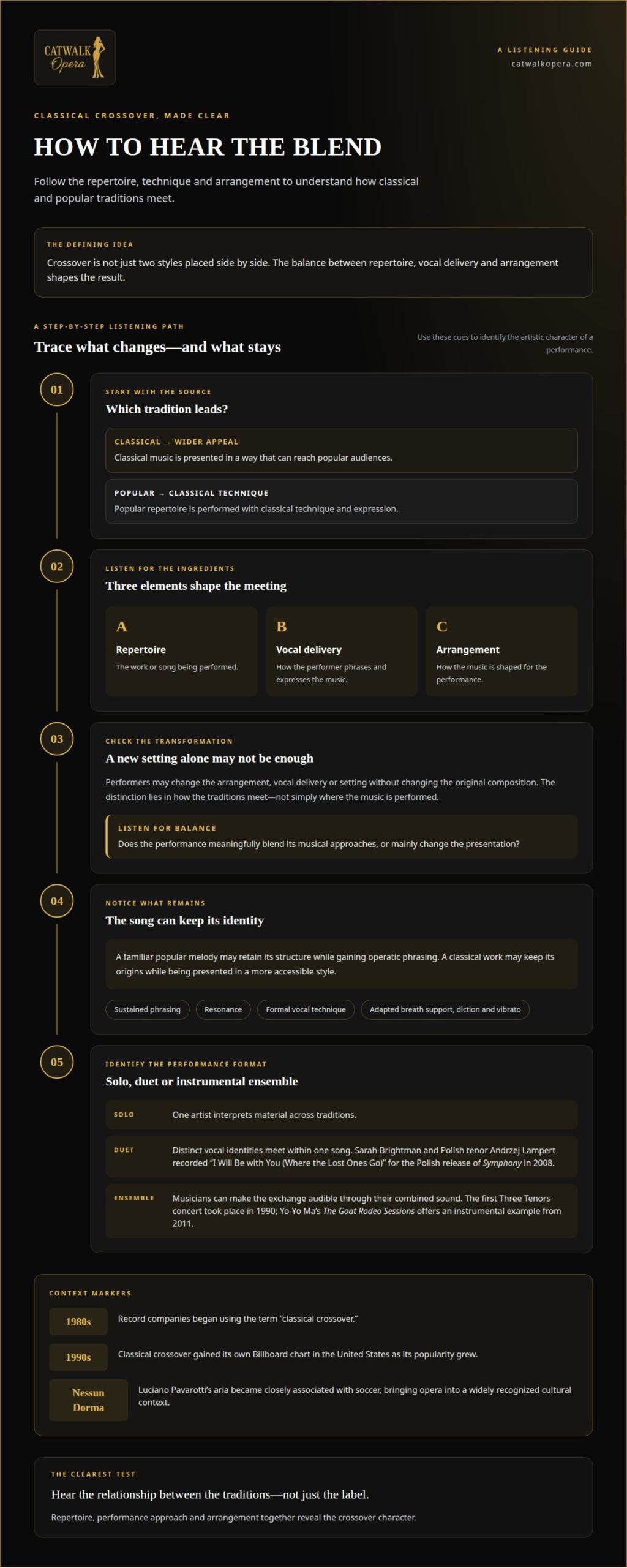
Classical crossover includes classical music presented for wider audiences and popular music performed with classical technique. Its boundaries remain debated because performers may change the arrangement, vocal delivery, or setting without changing the original composition. The distinction matters when identifying a performance’s artistic character: a familiar melody can retain its popular structure while gaining operatic phrasing, or a classical work can be presented in a more accessible style. The balance, rather than a single instrument or venue, defines the crossover.
Classically Trained Musicians in Popular Music
Classically trained musicians bring formal vocal or instrumental techniques to popular repertoire. Their careers can develop through ongoing musical study, performance experience, and selecting material suited to their abilities. Renée Fleming’s album Dark Hope, released in 2010, offers an example of a classical singer working with popular songs. For listeners, the training may shape phrasing, breath control, and tonal depth, while the repertoire creates a point of recognition beyond traditional classical audiences.
Popularizing Classical Music for Wider Audiences
Classical music can reach wider audiences through familiar settings, accessible presentation, or performances that connect with popular culture. Luciano Pavarotti’s “Nessun Dorma” became closely associated with soccer, bringing an operatic aria into a widely recognized cultural context. In the United States, classical crossover gained its own Billboard chart as it grew in popularity from the 1990s. That history signals recognition without reducing the style’s appeal to a single measure.
Popular Music in a Classical Manner
Performing popular music in a classical manner means applying classical vocal qualities to songs outside the operatic repertoire. Unlike opera, which centers on dramatic works written for operatic performance, crossover can reinterpret popular songs. Unlike conventional pop, it may emphasize sustained phrasing, resonance, and formal vocal technique. Artists adapt breath support, diction, and vibrato to suit each arrangement. The result preserves a song’s identity while giving it a more operatic character, a useful distinction when assessing repertoire or performance style.
Collaborations between classical and popular performers
Collaborations bring distinct musical traditions into one performance, with each artist contributing a recognizable style. The first Three Tenors concert took place in 1990, uniting Luciano Pavarotti, Plácido Domingo, and José Carreras in a shared classical presentation. Its significance lies in the collective format: individual voices retain their character while the ensemble creates a larger musical statement. For listeners and event planners, the example illustrates how collaboration can make classical artistry feel immediate and ceremonial.
Some collaborations pair a classical vocalist with a performer from another musical tradition. Sarah Brightman recorded “I Will Be with You (Where the Lost Ones Go)” with Polish tenor Andrzej Lampert for the Polish release of her album Symphony in 2008. The pairing places two voices within one song, allowing their different performance identities to shape its emotional character. A duet can therefore feel distinct from a solo crossover interpretation, even when it draws on a shared arrangement.
Instrumental collaborations can create crossover through the interplay of contrasting musical approaches. Yo-Yo Ma’s album The Goat Rodeo Sessions, released in 2011, provides an example of classical musicians working across stylistic boundaries. Rather than relying on a single vocalist to connect genres, an ensemble can make that exchange audible through its combined sound. The example broadens the idea of collaboration: crossover can be built through instrumental partnerships as well as through classical and popular singers sharing a performance.
For an event planner, these examples suggest practical ways to shape a live musical moment. A duet can put two contrasting voices at the center, while an ensemble collaboration can create a fuller exchange between musical styles. The choice should reflect the event’s purpose: a dramatic shared statement calls for a different arrangement than an intimate, voice-led moment. The Three Tenors, Brightman and Lampert, and Yo-Yo Ma’s project each demonstrate a different collaborative approach, rather than one fixed formula for crossover.
Definition of classical crossover
Record companies began using the term “classical crossover” in the 1980s. That history helps explain why the label can describe several artistic approaches rather than one prescribed sound. For listeners, it is useful to consider how a work’s origins and its presentation relate, instead of relying on the label alone.
One route begins with a classical work and changes how audiences encounter it. The Baroque period spans 1600 to 1750, and Antonio Caldara wrote an aria for his opera La costanza in amor vince l’inganno in 1710. A performance of historical repertoire can enter crossover territory when its presentation makes classical material accessible in a popular context. The composition’s origins remain classical, while its new framing changes how it reaches listeners.
A second route starts with an artist or repertoire associated with popular music and draws on classical forms of performance. Eileen Farrell released the crossover album I’ve Got a Right to Sing the Blues in 1960. Barbra Streisand’s Classical Barbra, released in 1976, offers another named example of an artist engaging with classical repertoire. These albums show why the category can describe different artistic choices, rather than one direction of influence.
To recognize the crossover in a specific performance, consider three elements: where the repertoire comes from, how the arrangement treats it, and what performance style shapes its character. The anthology 24 Italian Songs and Arias, for example, gathers classical vocal repertoire, while a popular song sung with classical phrasing represents a different point of entry. Neither a singer’s training alone nor a song’s title settles the classification. The defining feature is the audible relationship between traditions, which gives you a clearer basis for describing a performance.
Classical crossover ensembles and artists
Classical crossover artists and ensembles are best understood through their different approaches, not one fixed sound. The Piano Guys’ album Christmas Together, released in 2017, is one album example; Renée Fleming’s Voice of Nature: The Anthropocene, released in 2021, is another. A familiar song associated with crossover is “Nessun Dorma.” Together, these examples show how the category can include distinct repertoire and performance identities.
Ensembles bring crossover into focus by making collaboration central to the musical identity. Break of Reality was formed in 2003 at the Eastman School of Music. Its origin connects the group with a music-school setting, while its name has become one example of an ensemble associated with classical crossover. For listeners, a group offers a different point of attention from a solo artist: the character emerges through the combined performance, not only one voice.
Albums offer another way to trace an artist’s crossover choices. Christmas Together gives the Piano Guys a seasonal setting for their crossover work, while Fleming’s Voice of Nature: The Anthropocene presents a distinct album project. These titles let you explore the style through complete releases rather than isolated performances. Their contrast also shows that crossover is a broad category, not a single repertoire or mood.
For a planner or host, the useful takeaway is to choose a performance format that suits the event’s purpose. A solo artist can create a clear vocal focal point, while an ensemble brings several performers into the musical picture. Break of Reality and the Piano Guys illustrate why “ensemble” matters: a group’s identity differs from an individual artist’s, even within the same broad genre. Consider whether your event calls for one expressive center or a collective musical presence.
Catwalk Opera
Catwalk Opera brings classical crossover into a live setting for hosts seeking an artistic focal point tailored to their event. Led by international soprano Monika Spruch, the concept pairs operatic elegance with high-fashion presentation, creating a performance designed to complement the occasion’s atmosphere and purpose.
For a gala, fashion presentation, or private gathering, Catwalk Opera offers three distinct formats: the Luxury Opening Moment, the Signature Fashion Opera Experience, and the Private Royal Recital. Each is curated to align the musical direction and presentation with your event’s purpose, rather than relying on stock licensing. This is a natural next step when you want classical and popular influences expressed as a considered live experience.
If you are planning an event and would like to explore a tailored performance, contact Catwalk Opera.
Shape a Distinctive Musical Moment
As you shape your event, consider what guests should feel when live music enters the room. Anticipation, intimacy, or a theatrical arrival can guide the musical direction and its place in the evening. Understanding what a classical crossover artist brings helps you frame that choice around the atmosphere you want to create, rather than treating music as an afterthought.
For a luxury event, the strongest concept feels in harmony with its setting, visual language, and purpose. A fashion presentation may call for a striking entrance, while a private gathering may benefit from a more personal tone. These creative decisions give the performance a clear role in the event’s narrative and help it feel integral to the occasion.
Contact Catwalk Opera to discuss the artistic direction for your event. A considered musical moment can lend the evening a memorable sense of occasion.
Frequently Asked Questions
What is a classical crossover artist?
A classical crossover artist brings classical and popular musical traditions together through repertoire, interpretation, or presentation. The balance varies: one performer might apply classical vocal phrasing to a popular song, while another presents classical material in a broader popular context. The defining clue is the musical approach, not simply the performer’s training or the venue where the piece is heard.
What musical styles does classical crossover combine?
Classical crossover can connect opera, art song, and orchestral traditions with pop, rock, or other popular styles. The blend might come through song choice, arrangement, or the way a performer delivers a melody. For example, a contemporary song accompanied by orchestral textures creates a different crossover effect from an operatic aria presented in a popular cultural setting.
Who are famous classical crossover artists?
Recognized names include Renée Fleming, Luciano Pavarotti, Sarah Brightman, and Barbra Streisand, each associated with a different crossover context. Fleming’s performance of the National Anthem at the Super Bowl in 2014 brought a classical artist into a major American sporting event. These artists illustrate the range of the category, from operatic voices in popular settings to performers exploring classical repertoire.
What are common criticisms or risks associated with classical crossover?
Because classical crossover spans different traditions, listeners may disagree about where the category begins or ends. Some may feel an arrangement simplifies a classical work, while others may find an operatic approach changes the character of a familiar popular song. For performers and event planners, the practical risk is a mismatch between the interpretation and the audience’s expectations. Clear artistic direction helps the music feel intentional.