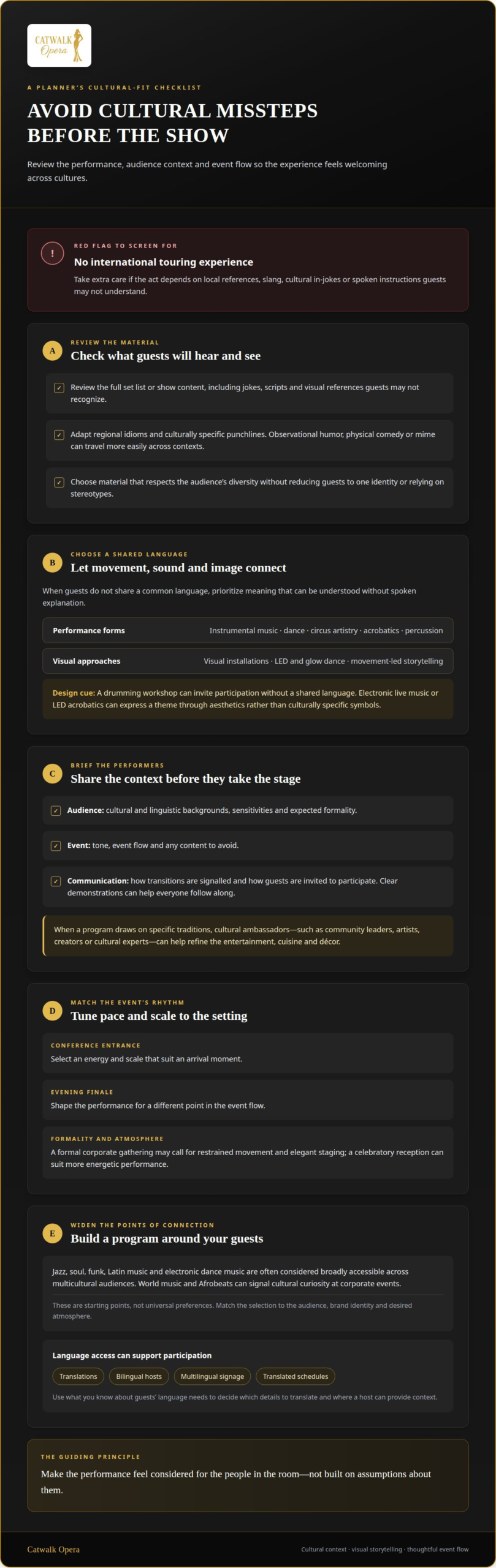
A key red flag when choosing entertainment for a multicultural audience is an act with no international touring experience, particularly if its material depends on local references, slang, or cultural in-jokes. Review the performance content and consider whether music, movement, or visual storytelling can connect across language differences. A clear briefing on guests’ cultural and linguistic backgrounds, sensitivities, and the event’s tone helps you make a thoughtful choice.
Looking beyond whether an act is polished is worthwhile: cultural fit can shape how guests experience the entire event. The strongest choice respects the audience’s diversity without reducing it to one identity or relying on stereotypes.
This guide explores how audience makeup, cultural nuance, and nonverbal performance affect suitability, and how format and pacing can broaden an act’s appeal. It also explains how a carefully curated operatic performance can bring visual distinction to an international gathering.
Key Takeaways
- Look beyond performance polish: material built on local slang, cultural in-jokes or unadapted references may not travel well across an international audience.
- Consider instrumental music, movement and visual performance when guests do not share a common language.
- Shape the entertainment around the audience’s cultural makeup, event purpose and desired atmosphere rather than relying on a one-size-fits-all choice.
- Review how each performance fits the event’s pacing and contributes to a welcoming, memorable experience for guests.
How do you avoid cultural missteps when booking entertainment?
In major US cities, discover multicultural entertainment through cultural arts organizations, community festivals, and event agencies that curate international performers. Choosing entertainment for a multicultural audience means matching the act’s content and format to guests’ cultural expectations.
Adapting Idioms, Humor, and References
Cultural adaptation reshapes language, humor, and references so they make sense across cultural contexts. Regional idioms and local jokes, for instance, can leave some guests outside the moment. Replace slang and culturally specific punchlines with observational humor, physical comedy, or mime. A comic scene about a workplace mishap, for example, may travel better than a joke about regional customs. Review scripts and set lists for references guests may not recognize.
Formats That Appeal Across Cultures
Cross-cultural formats invite connection through participation, sound, or visual design rather than insider knowledge. A drumming workshop, for example, can involve guests without requiring a shared language. At a futuristic event, electronic live music or LED acrobatics can express the theme through aesthetics rather than culturally specific symbols. If one cultural group is the majority, pair broadly appealing headline entertainment with supporting moments that reflect the wider guest mix.
Audience makeup also matters when shaping culturally targeted media and health messaging. For a diverse community, use language and imagery that reflect the intended audience rather than assuming one message suits everyone. Translate key health information, then review idioms and references for differences in meaning. Greetings, colors, and traditions can also shape expectations, so tailor the presentation to the event’s cultural context.
Involve cultural ambassadors in planning when a program draws on specific traditions. Community leaders, artists, creators, or cultural experts can help refine entertainment, cuisine, and décor. Before booking, brief performers on guests’ cultural and linguistic backgrounds, sensitivities, and expected formality. Review the full set list or show content, including jokes and visual references. In major US cities, cultural organizations and festivals can also help you discover artists connected to local communities.
Nonverbal performance for audiences without a shared language
For a corporate conference with guests who speak different languages, choose acts whose meaning comes through movement, music, or visual storytelling. Instrumental performances, dance, circus artistry, acrobatics, visual installations, and percussion can connect without spoken explanations.
Sports entertainers, dancers, and hoop performers put physical skill on clear display. A basketball trick sequence, choreographed dance, or hoop artist’s flowing movements gives guests an immediate focal point. LED and glow dance performances add luminous visual elements, making patterns and gestures easy to see across a large room. Match the act’s pace and scale to the setting: a conference entrance calls for different energy than an evening finale.
Brief performers on the audience’s cultural and linguistic makeup, sensitivities, and the event’s tone. A formal corporate gathering, for example, may call for restrained movement and elegant staging, while a celebratory reception can accommodate a more energetic performance. Share the event flow and any content to avoid, so the act’s gestures, music, and visual choices feel appropriate. Review the complete set or show content before booking.
A lack of international touring experience is a red flag for an act intended for a global audience. Also consider whether the performance depends on spoken instructions, local references, or audience participation guests may not understand. Ask how performers communicate transitions and invite participation. Clear demonstrations can help everyone follow along without relying on language.
Typical prices for multicultural performers in the US vary by performance format, duration, travel, and production requirements. Pricing depends on the event and is provided after a quote request.
Measure engagement through observable participation, audience attention during the performance, and post-event feedback. A brief survey can ask whether guests found the act welcoming and suited to the occasion. Compare their responses with participation and audience movement during the performance.
For an event that calls for refined, visual storytelling, consider curated performance for international events.
Expanding audience reach
Broader reach comes from programming that offers guests more than one point of connection. At a national corporate gathering, musical style, language access, and event pacing can influence who feels included and how actively guests participate.
Jazz, soul, funk, Latin music, and electronic dance music are often considered broadly accessible across multicultural audiences. World music and Afrobeats can also signal cultural curiosity at corporate events. These are starting points, not universal preferences: match the selection to the audience, brand identity, and desired atmosphere. A polished jazz interlude, for example, can suit a reception, while Afrobeats may bring a more rhythmic energy to an evening celebration.
Language access adds another dimension of welcome. Translations, bilingual hosts, and multilingual signage can help guests follow key event information and participate more easily. At an international conference, bilingual introductions can clarify transitions, while translated schedules help attendees understand the program. Use what you know about guests’ language needs to decide which details to translate and where a host can provide context.
Format matters as much as genre. A mixed program can shift the energy across an evening, but its acts should complement one another, with transitions planned deliberately. For example, a musical welcome can lead into a spoken program, followed by a more expressive performance after dinner. This progression gives guests distinct ways to connect without making the event feel fragmented.
Brand communication can also influence whether guests feel represented. One study found that 69% of Black consumers are more inclined to purchase from brands whose advertising positively reflects their race or ethnicity. For a luxury brand launch, consider how the entertainment and visual language express the brand’s values, rather than treating cultural references as decoration. A considered cultural statement can create a more meaningful connection than a generic spectacle.
Use guest feedback and participation patterns to refine future programming. If translated signage helps attendees move confidently between sessions, retain it. If a musical segment draws guests onto the dance floor, consider how its style and placement shaped that response.
How audience makeup shapes entertainment choices
Start with the guest mix, not a cultural label. Nearly 40% of the US population is multicultural, but that figure alone cannot predict individual preferences. Age, language, event purpose, and familiarity with a style all shape how guests respond. A global corporate gala may bring together colleagues with different expectations, even when they share a workplace.
Music and performance preferences vary across cultures, generations, and personal experience. No single genre represents an entire community. One guest may value familiar musical traditions, while another prefers contemporary international sounds. A formal awards evening and a relaxed networking reception, for example, call for different pacing and atmosphere, regardless of who attends. Treat audience makeup as context, not a shortcut to assumptions.
Consider the narrative guests encounter from arrival to closing. A storytelling performance may convey meaning through lyrics, movement, costume, or visual design, and each element can resonate differently with an international audience. At a fashion event, a dramatic visual entrance can create a shared focal point without asking guests to recognize a specific tradition. At a corporate gathering, a restrained opening may better suit the event’s purpose and atmosphere.
Build variety through event flow rather than stacking unrelated acts. A musical welcome, a concise central performance, and ambient interludes can create distinct emotional moments while maintaining coherence. For example, place a high-energy act after formal remarks instead of interrupting a keynote. Gather audience insight through post-event comments and participation, then use that response to shape future programming. To plan a tailored performance around your event’s audience and atmosphere, discuss a bespoke event performance.
Catwalk Opera
Catwalk Opera offers a refined performance option when an international event calls for visual storytelling and a distinctive musical presence. Its operatic artistry can make a cultural statement without relying on spoken humor or references guests may not share.
Choose the Luxury Opening Moment to establish the evening’s atmosphere, or the Signature Fashion Opera Experience to bring vocal artistry and fashion presentation together. For an intimate gathering, the Private Royal Recital offers a more personal setting. Consider each option in relation to your event objective, audience, and desired flow.
If you are shaping a gala, fashion event, or private gathering, contact Catwalk Opera to discuss your occasion.
Shape a shared moment for your guests
Consider the feeling you want guests to carry beyond the room. A carefully chosen performance can become part of the event’s identity, shaped by its setting, visual language, and place in the evening. For entertainment for a multicultural audience, let that artistic intention guide the details rather than asking one performance to represent every guest’s experience.
Consider how the performance will fit within the wider design: the entrance, lighting, pace, and transition to the next part of the gathering. A thoughtful relationship between these elements can give the evening a distinctive point of view while keeping the experience welcoming. The aim is not to flatten cultural differences, but to create space for guests to share a memorable occasion.
When you are ready to explore a performance shaped around your event, contact Catwalk Opera to discuss your event. A thoughtful creative direction can help your gathering leave a lasting impression.
Frequently Asked Questions
Are there any red flags to watch for when reviewing an act’s suitability for a multicultural event?
Watch for an act whose presentation depends on unpredictable audience participation or whose tone shifts sharply between promotional samples and live footage. These signs can make it difficult to judge how the performance will feel in your room. For example, a polished event reel without a clear description of the live sequence leaves questions about pacing. A consistent, clearly described presentation makes planning more straightforward.
How do I brief a performer on my multicultural audience without overcomplicating the process?
Send a concise run sheet with the performer’s arrival time, entrance cue, set position, and finish time. Include pronunciation notes for any names or words spoken onstage, along with the event-day contact’s name. A gala brief, for example, can specify the host’s introduction and the cue for the performer’s entrance. One clear document keeps coordination orderly.
How does audience composition affect entertainment choices?
The performance’s fit depends on the room and the occasion. A seated awards dinner, for example, calls for different staging from a reception where guests move between conversations. Consider whether guests will focus on a stage, gather around a central space, or spread across several rooms. This practical picture helps you select an act whose presence remains visible and appropriate.
Should you book one act or a mixed lineup for a multicultural event?
One act can create a clear artistic focus and simplify stage coordination. A mixed lineup can add contrast, but each transition needs a place in the run sheet and a clear cue for the host or stage manager. A program with several performers, for example, benefits from planned introductions and defined changeovers. Choose the format that fits your schedule and production arrangements.
What entertainment formats work without a shared language?
Choose performances with a visual sequence that is easy to follow without spoken explanation. A recurring movement, recognizable visual motif, or musical phrase can help guests follow how a piece develops. For instance, a dance performance that returns to one visual theme gives the audience a thread to follow. Avoid formats where understanding depends on reading projected text or recognizing a specific spoken reference.
What entertainment works for a multicultural audience?
For a luxury gala or fashion event, a visually composed vocal performance can bring musical artistry and event design together in one focal moment. The right selection depends on the atmosphere you want to create: a poised entrance, an elegant interlude, or a prominent centerpiece. Consider how the performance’s scale, staging, and placement will complement the room and the event’s overall aesthetic.