The most inviting contemporary classical music for parties pairs memorable melodies with distinctive modern sounds. Start with Arvo Pärt’s Cantus in Memory of Benjamin Britten, Eric Whitacre’s Ghost Train, and Morten Lauridsen’s choral setting of “Sure On This Shining Night” for a varied listening list.
It is understandable to wonder whether contemporary classical music will feel too demanding for a social occasion. The right selection can instead add atmosphere and character, with pieces that invite attention without requiring guests to know the musical language in advance.
This guide introduces approachable works and shows how contrasting moods can suit different moments, from an elegant arrival to a more animated gathering. Use it as a starting point for listening and for considering the pace, texture, and overall character you want your party to have.
Key Takeaways
- Start with modern works whose melodic or atmospheric qualities make them inviting, then explore more distinctive textures as the gathering unfolds.
- Use the listening recommendations to find pieces suited to different moods, from a graceful dinner backdrop to a more animated party moment.
- Shape playlist flow by varying tempo and intensity, allowing transitions to support conversation and the changing energy of the event.
- For a live artistic centerpiece, explore Catwalk Opera’s Luxury Opening Moment, Signature Fashion Opera Experience, or Private Royal Recital.
1. Accessible modern classical music
Approachability comes from a clear musical image, not from familiarity with classical traditions. Alan Hovhaness’s Symphony 2, “Mysterious Mountain,” composed in 1955, offers a spacious, atmospheric starting point. John Adams’s The Dharma at Big Sur, composed in 2003, brings a more contemporary sound while retaining a strong sense of place. These works let guests listen casually or settle into closer attention.
For a more intimate mood, Benjamin Britten’s Nocturnal, Op. 70, after John Dowland, dates to 1963. Its connection to Dowland’s song “Come, Heavy Sleepe,” from 1597, gives listeners a historical thread without requiring musical expertise. Toru Takemitsu’s From Me Flows What You Call Time, composed in 1990, runs for 25 minutes. Its extended scale suits a focused listening moment better than a short transition between conversations.
For recorded music at a party in the United States, licensing depends on whether the gathering is private or public, the venue, and how guests access the event. Public or commercial use can raise performance-rights questions. Clarify responsibility with the venue or relevant rights administrator before playing recorded works.
There is no single cost for hiring a contemporary classical ensemble for a party. The quote depends on ensemble size, performance length, travel, and production requirements, and is provided after a quote request.
For live contemporary classical music at a private event in the United States, search by city and ensemble format through artist-booking directories, local arts organizations, or university music departments. A chamber ensemble may suit a listening-focused gathering, while a solo performer can fit a more intimate setting.
To make modern repertoire welcoming, pair contrasting works rather than stacking unfamiliar textures. A Hovhaness selection can establish an expansive opening, while Adams can add a contemporary character. Consider room size and conversation, too: a piece with a clear atmosphere can enrich a reception, while a longer work asks guests for more sustained attention. This distinction helps shape an elegant musical setting around the event’s purpose.
2. Listening recommendations
Build your listening shortlist around the atmosphere you want, rather than choosing by composer alone. David Del Tredici’s Final Alice, composed in 1976, offers a theatrical vocal-orchestral direction. Meredith Monk’s Piano Songs, released in 2014, suggests a more intimate piano-led option. These contrasting starting points help you hear how contemporary repertoire can shift a room’s character.
For dancing or a lively party, try Igor Stravinsky’s The Rite of Spring, whose premiere took place in 1913. Its forceful rhythms and changing intensity can bring movement and dramatic energy. It predates the modern-composition survey beginning in 1950, so treat it as a vivid precursor rather than a contemporary work.
For a quieter interlude, consider Jaakko Mäntyjärvi’s Canticum Calamitatis Maritimae, composed in 1997. Its subject is the 1994 Estonian passenger ferry disaster, which killed 852 people. The serious subject matter makes it better suited to attentive listening than a celebratory dance moment. Context matters as much as sound when selecting music for guests.
Try these listening steps before finalizing your choices:
- Sample a passage. Listen to a short excerpt from Final Alice and note its vocal and orchestral character.
- Compare the energy. Place a section of The Rite of Spring beside a piano selection from Monk’s Piano Songs.
- Match the setting. Reserve Mäntyjärvi’s work for a reflective moment, not a dance-floor transition.
These recommendations are listening prompts, not a fixed party sequence. You can shape a contemporary classical selection around the occasion’s mood, guest attention, and desired pace. If you want the music to become a live focal point, explore a bespoke musical experience designed for an event setting.
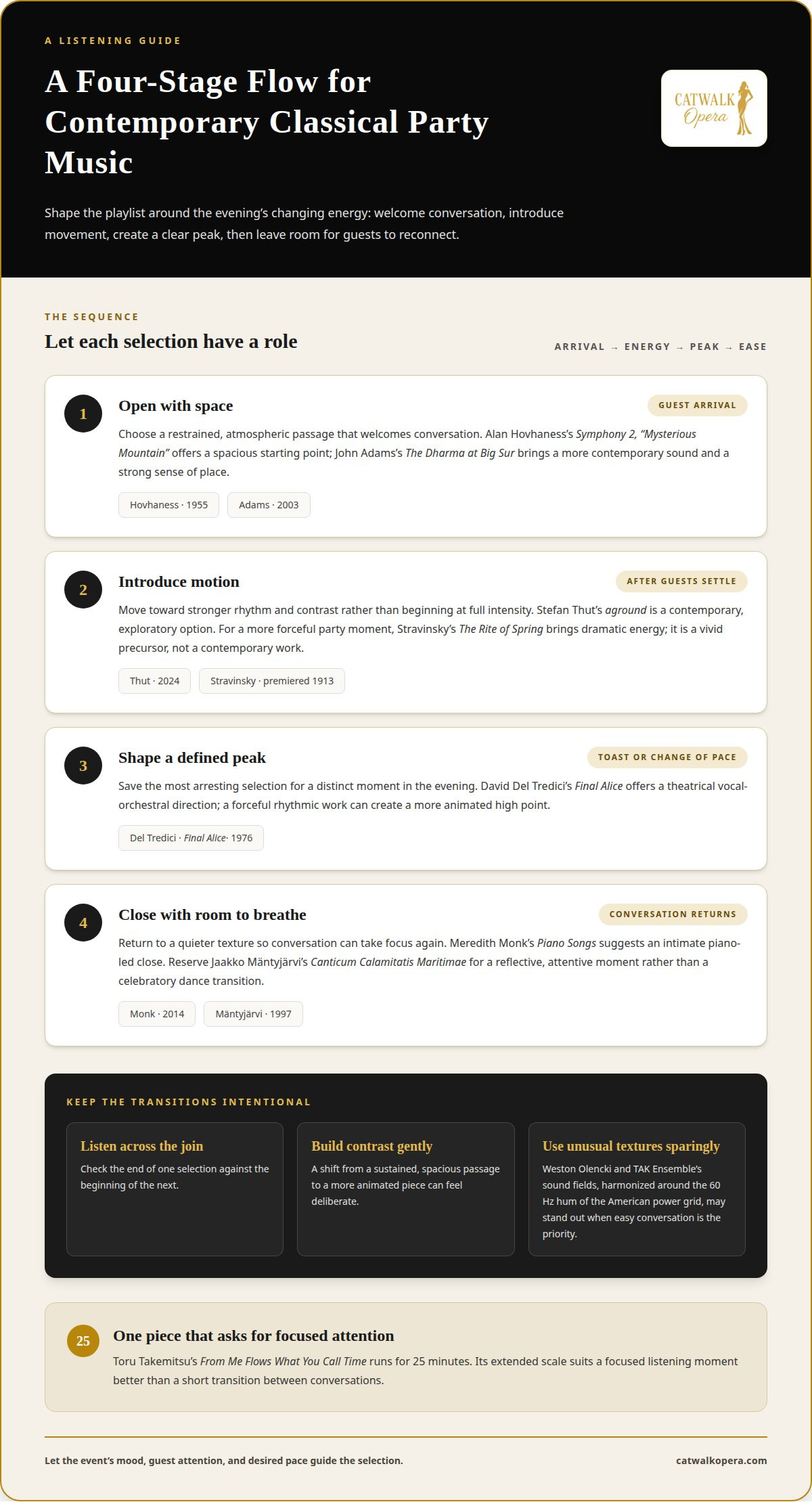
3. How can I build a contemporary classical party playlist with a good flow and mix of tempos?
Begin with the event flow, then assign each musical choice a role. For an arrival, choose a work whose texture welcomes conversation. Later, introduce stronger rhythmic contrast, then soften the atmosphere as guests move toward dinner or departure. Stefan Thut’s aground, composed in 2024, can represent a contemporary, exploratory choice within that arc.
Build transitions around contrast, not abrupt changes in volume or style. A shift from a sustained, spacious passage to a more animated piece can make the change feel deliberate. Weston Olencki and TAK Ensemble’s work, with sound fields harmonized around the 60 Hz hum of the American power grid, offers an example of an unusual sonic texture. Use such a piece sparingly if the gathering prioritizes easy conversation.
Try this sequence when arranging your selections:
- Set the opening mood. Choose a restrained passage for guest arrival, and keep the first transition gentle.
- Introduce motion. Place a more rhythmically assertive work after guests have settled, rather than opening at full intensity.
- Shape a peak. Reserve the most arresting selection for a defined moment, such as a toast or a change in the evening’s pace.
- Close with space. Return to a quieter texture so conversation can take focus again.
Check the transitions by listening to the end of one selection and the beginning of the next. Robert Nasveld’s tape works, made between 1974 and 1984, can offer a distinct textural contrast against acoustic ensemble recordings. For a polished playlist, place that contrast where it feels intentional, rather than treating novelty as a substitute for flow. Keep the event objective in view: a reception, dinner, and dance-oriented gathering call for different energy curves. A carefully shaped sequence lets contemporary music feel composed for the occasion, not simply assembled from striking titles.
4. What contemporary classical music works well as background music for dinner parties?
For dinner, select works that create a considered atmosphere without demanding constant attention. Morton Feldman’s Rothko Chapel, composed in 1971, can suit a reflective interval between courses. Its restrained character gives the room space for conversation, while its distinctive musical language rewards guests who choose to listen more closely.
Arvo Pärt’s Cantus in Memory of Benjamin Britten, composed in 1977, offers another contemplative option. In one passage, the first violins hold the note C for more than 250 beats. That sustained sound can create a sense of stillness, making the piece more fitting for a quieter dining moment than an energetic arrival.
Eric Whitacre’s When David Heard, composed in 1999, is a choral work with a serious emotional character. Its expressive intensity may suit a formal gathering with a deliberate listening moment, but it could feel weighty during lively dinner conversation. Consider the occasion’s tone as carefully as the piece itself.
Use these selection principles to keep dinner music atmospheric:
- Choose by texture. Feldman’s Rothko Chapel offers a reflective contrast to a room filled with conversation.
- Reserve sustained passages. Pärt’s extended violin note can frame a pause or a transition between courses.
- Match emotional weight to the occasion. Whitacre’s When David Heard suits attentive listening more than a light, social stretch.
- Preview transitions. Listen to the opening and closing moments of each selection, so shifts in intensity feel intentional.
A polished dinner sequence might move from Feldman’s meditative atmosphere to Pärt’s sustained stillness, then introduce Whitacre when guests can give it attention. Keep the overall sound discreet enough for conversation, and let each composition shape the room rather than compete with it. These choices make contemporary classical music for parties feel tailored to the dining experience, with a distinct mood for each moment.
David Del Tredici’s Alice works explore the real-world people behind the Alice in Wonderland stories, including 11-year-old Alice Pleasance Liddell. Their subject matter may add a literary note to a dinner program.
Catwalk Opera
Catwalk Opera brings contemporary classical and crossover artistry to live events, with performances curated for the setting, audience, and occasion. Led by international soprano Monika Spruch, its performances pair refined vocal artistry with cinematic, high-fashion presentation. This offers a distinctive live option when a playlist alone cannot create the atmosphere or focal moment you envision.
The Luxury Opening Moment, Signature Fashion Opera Experience, and Private Royal Recital each offer a distinct way to bring live performance to a gathering. Their curated musical character can suit the occasion, whether you are hosting an elegant dinner, private celebration, or high-profile event.
Contact Catwalk Opera to discuss your event and the atmosphere you would like to create.
Shape the Atmosphere You Want Guests to Remember
A carefully curated selection of contemporary classical music for parties can express an occasion’s character before a single toast is made. Decide what you want guests to feel: welcomed into an intimate evening, drawn into a dramatic entrance, or immersed in a distinctive cultural statement. Let that intention guide the balance between recorded listening and a live focal moment.
For a private celebration, luxury gala, or fashion-led gathering, consider how music can complement the lighting, styling, and visual design of the room. A live performance brings an immediate human presence, while thoughtful musical choices help the evening feel cohesive rather than simply arranged. The result can be personal, elegant, and unmistakably yours.
If you are considering live artistry for your event, contact Catwalk Opera to begin a conversation about the atmosphere you envision. Your musical direction can become an expressive part of the occasion, crafted with care and confidence.
Frequently Asked Questions
What contemporary classical music works are suitable for parties?
For a reflective cocktail hour, consider Eve Beglarian’s A Murmur in the Trees or Cassandra Miller’s “Guide.” Beglarian based the score on birch-bark patterns, while Miller drew inspiration from Maria Muldaur’s 1968 recording of “Guide Me, O Thou Great Jehovah.” Their distinct points of departure give you conversation pieces with a story, better suited to a listening pause than an energetic dance moment.
Which modern classical composers create upbeat, accessible party music?
Upbeat character depends on the individual work, so a composer’s name alone is not a reliable party cue. Andrew Hamilton’s “Proclamation of the Republic,” which uses the text of Ireland’s 1916 independence declaration, offers a text-led option with a clear historical reference. Sample a passage and assess its pulse, intensity, and vocal clarity against the mood you want for your gathering.
What are the best contemporary classical albums for a cocktail party?
Choose an album whose sequence supports conversation rather than demanding uninterrupted attention. Look for recordings with distinct shorter tracks, varied textures, and a consistent overall tone; reserve long-form works for dedicated listening. Preview each track’s opening and ending, then arrange selections so changes in intensity feel deliberate. This approach lets you adapt the listening experience to the room and the evening’s atmosphere.