The most famous performer is not always the right choice. To understand how to choose a performer that matches brand values, assess whether their public reputation, artistic identity, and conduct align with your brand’s ethos. Then consider how their style will serve the event, and agree on performance details and expectations before booking.
A polished profile or impressive following may catch your attention, but the partnership should feel credible in the room as well as on screen. Choose an artist whose presence supports the occasion rather than competes with it. This guide covers how to assess values, credibility, and creative fit, then set clear expectations for the collaboration. You’ll also see how bespoke live artistry can shape a considered cultural statement for a luxury gala, fashion presentation, or private celebration.
Key Takeaways
- Review a performer’s public conduct and audience interactions to assess credibility beyond their profile or reputation.
- Look for a creative style that feels authentic to the performer while complementing your brand’s visual identity.
- Compare the performer’s demonstrated interests and values with your brand’s ethos and event objective.
- Set clear expectations for the performance, creative input, deliverables, and how the collaboration will unfold.
Checking for controversies and fake engagement
Measure success against the event’s objective by assessing relevant reach, meaningful engagement, and the response you intended. A practical approach to how to choose a performer that matches brand values considers both reputation and audience interaction. For a fashion presentation, relevant audience interest may matter more than follower growth.
- Review the performer’s public history across social media before discussing an endorsement. Search their name alongside relevant terms, then read original posts and reliable reporting rather than relying on cropped screenshots. Look for patterns, such as inflammatory comments or inconsistent public positions, and consider whether they conflict with your brand’s stated values. Record examples in context.
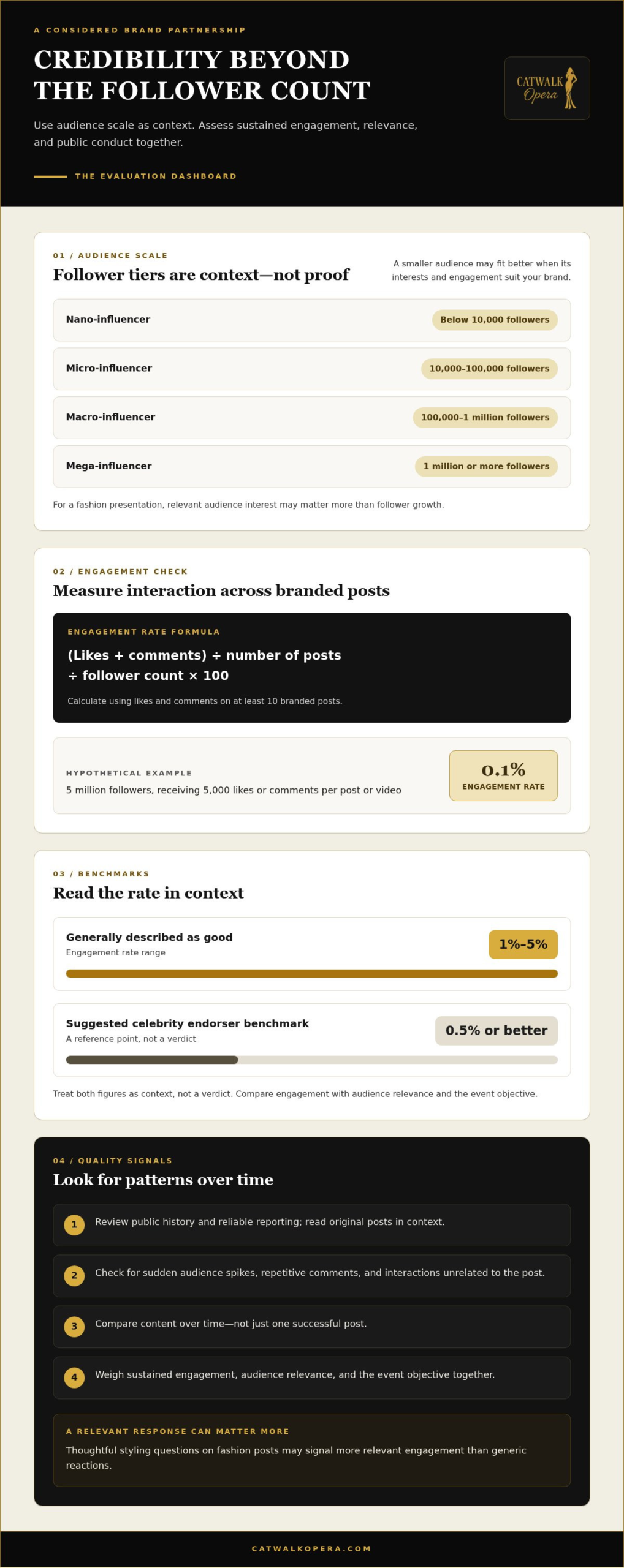
- Use follower tiers as context, not proof of influence. One common classification places nano-influencers below 10,000 followers, micro-influencers at 10,000 to 100,000, macro-influencers at 100,000 to 1 million, and mega-influencers at 1 million or more. A smaller audience may still fit better when its interests and engagement suit your brand.
- Calculate engagement rate using likes and comments on at least 10 branded posts. Add those interactions, divide by the number of posts, divide again by follower count, then multiply by 100. A rate between 1% and 5% is generally described as good; 0.5% or better is a suggested benchmark for celebrity endorsers. Treat these figures as context, not a verdict.
- Look for sudden audience spikes, repetitive comments, and interactions unrelated to the post. Compare content over time instead of judging a single successful post. For example, a performer whose fashion posts prompt thoughtful styling questions may have more relevant engagement than one receiving generic reactions. When considering how to choose a performer that matches brand values, weigh sustained engagement, audience relevance, and the event objective together.
An influencer engagement rate measures how often followers engage with content, including views, likes, comments and shares. A hypothetical celebrity with 5 million followers receiving 5,000 likes or comments per post or video has an engagement rate of 0.1%.
Brianna Doe has nearly 250,000 followers. Nano-influencers are categorized as having 1000-10,000 followers, mid-tier influencers as having 50,000-250,000 followers, and mega-influencers as having 1,000,000+ followers.
Creative freedom and authentic endorsements
Build the collaboration around shared principles and a performance the audience can believe in. These steps help define the fit before you agree on creative direction.
-
Define Brand Values
Write down the principles your brand demonstrates through its decisions, imagery, and customer experience. Choose priorities such as craftsmanship, cultural expression, or discretion, then connect each to an observable example. How do you define brand values before choosing a performer? Describe what those principles look like in practice and identify conduct or messaging that would contradict them. This gives your selection a clear standard.
-
Compare Performer and Brand Audiences
Compare the performer’s audience profile with your intended customers, using relevant demographics and interests rather than follower totals alone. Ask whether the audience’s expectations suit the event, product, and campaign message. How do you compare a performer’s audience with your target customers? Review available platform insights alongside your customer profile, then note meaningful overlaps and gaps. The audiences need not be identical for the alignment to support awareness.
-
Assess Ambassador Credibility and Authenticity
Review past endorsements and ask whether the performer can speak naturally about your brand. A celebrity who has previously supported similar values may feel more credible than an unexpected pairing. Invite creative input early: the 2024 Influencer Marketing Report found that 65% of influencers want involvement in creative or product development conversations early in a project.
How do you address legal rules for using a performer’s name, image, or endorsement in advertising? Set permissions, channels, duration, approval steps, and disclosure responsibilities in the agreement. Requirements depend on the campaign and jurisdictions involved. How much does booking a performer for a U.S. brand event or campaign cost? Pricing depends on the event scope, creative requirements, and logistics. Catwalk Opera provides pricing on request.
Alignment between an ambassador’s values and brand ethos
Assess alignment through the performer’s public interests, past choices, and connection to your target audience. Shared values matter most when they feel credible beyond a single campaign.
-
Assess Topical Alignment and Shared Values
Review what the performer discusses and supports in interviews, social media, and past partnerships. If your brand champions cultural access, for example, look for someone whose public work reflects that interest. A sustained pattern is stronger evidence than a single campaign post. Consider whether the performer’s interests naturally connect with your product, event, or cause, rather than choosing them solely for their follower count.
For influencer marketing, compare the performer’s recurring themes with the message you want audiences to remember. A fashion label promoting craftsmanship, for example, may fit an artist who speaks about artistry and detail. Check whether previous endorsements conflict with your values or compete directly with the campaign. Aim for a genuine connection consumers can understand, not a temporary pairing designed only to attract attention.
-
Evaluate Fit With the Brand Ethos
Compare the performer’s conduct and public image with the experience your brand promises. Consider tone, visual identity, and audience interaction. A discreet luxury house, for instance, may prefer a measured presence to someone known for provocative promotion. What criteria help assess whether a performer aligns with a brand’s values and audience? Look for consistent values, relevant interests, compatible communication, and a credible connection to your target customers.
Test the proposed creative direction against those criteria. Ask whether the performer can express the brand message in their own voice without distorting its meaning. Social media content, event appearances, and interviews each create different impressions, so assess the full campaign context. A less famous performer may be more suitable than a high-profile figure who is a poor fit. Record the reasons for your choice and use them to guide approvals and assess awareness after the collaboration.
Creative freedom and clear collaboration expectations
Agree on creative boundaries, practical deliverables, and measures of success before signing. A clear partnership gives the performer room to contribute while protecting the campaign’s purpose.
- Set deliverables in writing. Specify the performance or content, event date, location, timing, promotional channels, approval process, and any required brand mentions. For a runway presentation, describe where the performance fits into the event and what the audience should take away. Clear details prevent different assumptions about what the performer will promote.
- Ask the performer or agent how they would interpret your brief, what creative input they need, and which recommendations they would make for the target audience. Clarify prior commitments, scheduling, and how they handle revisions or audience comments. The 2024 Influencer Marketing Report found that 65% of influencers want early involvement in creative or product development conversations.
- Define contract terms for deliverables, payment timing, cancellation, content approvals, usage rights, exclusivity, and disclosure responsibilities. State where the performer’s name, image, or recorded material may appear, for how long, and who approves each use. For example, distinguish event photography from permission to use the campaign in future advertising. These terms clarify expectations; have counsel review them for your circumstances.
- Allow meaningful artistic interpretation within agreed brand boundaries. You might specify the event’s tone, visual direction, and key message while leaving the performer freedom over expressive choices. Decide how you will measure results, such as relevant audience responses, campaign reach, qualified enquiries, or guest feedback. Choose measures that match the event objective rather than relying only on likes or comments.
For a live performance shaped around your event’s identity, explore a bespoke performance concept.
Clearly negotiate partnership deliverables, such as the number of posts or story mentions. Tie each item to the campaign’s purpose and specify its format, timing, and channel, so both sides can distinguish required content from optional ideas. If the scope changes during planning, confirm revised expectations and approval needs in writing. This keeps the collaboration flexible while giving the performer a clear framework for contributing authentically.
Catwalk Opera: Luxury Opening Moment
Catwalk Opera’s Luxury Opening Moment brings live operatic artistry into the first impression of a luxury event. Led by international soprano Monika Spruch, it can frame a runway, gala entrance, or brand reveal with a distinctive cultural statement. The performance lasts between 3 and 5 minutes, giving you a focused artistic moment within the event flow.
For a fashion presentation with a broader creative concept, the Signature Fashion Opera Experience brings operatic elegance into dialogue with high-fashion design. The Private Royal Recital offers a more intimate setting for an exclusive gathering. Each suits a different event objective, from a cinematic opening to an elegant centerpiece.
If this artistic direction suits your event, contact Catwalk Opera to discuss your plans.
Shape Your Event’s Signature Moment
Turn your brand principles into an experience guests can feel. The question of how to choose a performer that matches your brand values becomes more focused when you define the atmosphere you want to create, the role the performance should play, and the impression guests should carry beyond the event. Keep these priorities at the heart of your creative brief.
Catwalk Opera offers the Luxury Opening Moment, Signature Fashion Opera Experience, and Private Royal Recital. Each brings a distinctive live-performance presence to a different setting, from a fashion presentation to an intimate gathering. Share your event’s purpose and creative vision with Catwalk Opera to discuss the right approach.
Contact Catwalk Opera to discuss performers and take the next step toward an event that feels unmistakably your own.
Frequently Asked Questions
How can you research a performer’s public image, past statements, and reputation?
Review the performer’s interviews, archived posts, reputable press coverage, and event footage. Search exact phrases from notable statements to find their original context rather than relying on reposts. Compare their public presentation across platforms and over time. For a high-profile booking, document dated sources and distinguish verified reporting from opinion before sharing your findings with your team.
What risks can arise from a performer’s controversial behavior or brand misalignment?
Controversial conduct can shift attention from your event to the performer, invite critical comments, or make a campaign appear inconsistent with your principles. Misalignment can weaken audience trust and complicate future partnerships. For example, a public statement opposing a cause central to a charity ball can overshadow its purpose. Weigh the issue’s context and relevance to your brand before deciding whether to book.